Tag: connecticut

Save the Date! Sunday, May 19, 2019

Announcing the 2nd Annual Buzzy Levin Golf Tournament & Awards Banquet.

Dear Alumni, Friends and Family

You’re invited to take part in the 2nd Annual Buzzy Levin Golf Tournament & Awards Banquet at Blackledge Country Club in Hebron, CT, on Sunday, May 19, 2019

The GHTBL gives back to charitable organizations in our Greater Hartford community on an annual basis.  Games are scheduled once a year at Dunkin’ Donuts Park in Hartford and the ticket proceeds are given to charity.  Our 2018 Charity Series at Dunkin’ Donuts Park raised $4,500 for Connecticut Children’s Medical Center and our 2017 series gave raised $5,641 for Camp Courant.

Before we can give back in 2019, we must first fund our league.  The GHTBL relies on donations and sponsorships to pay rising costs.  Your involvement in this event and your donations fund the costs of fields, umpires, and equipment.  Your generosity is greatly appreciated.

Go to GHTBL.org/Donate to reserve your spot in the 2nd Annual Buzzy Levin Golf Tournament & Awards Banquet.

Go to GHTBL.org/Sponsor to become a Tee Sponsor or Presenting Sponsor


The itinerary will be as follows:

1 PM – WELCOME
Have lunch, chat with old teammates, and buy raffle tickets ($20).

2:00 PM – TEE OFF
Foursomes to play a scramble format (groups use the best shot).

7:00 PM – AWARDS BANQUET
Dinner is served.  2017 awards winners are presented with trophies and plaques.  Dinner is included for golfers otherwise the price is $30 per person to attend dinner.

7:45 PM – RAFFLE
Raffle winners to be announced.

Malloves Jewelers Returning to Sponsor Middletown Team

Malloves previously sponsored a franchise from 1980 to 1993.

The Greater Hartford Twilight Baseball League is pleased to welcome back a longtime team sponsor next season. Malloves Jewelers will once again support our Middletown-based franchise.   

From 1980 to 1993, Malloves Jewelers and their owner, Jerome “Buzzy” Levin were a vital part of the GHTBL. Buzzy would later be named to the GHTBL Hall of Fame (Sponsor Division) recognizing his generous support of the league. His son Marc Levin, current owner and President of Malloves Jewelers, graciously agreed to fund the existing Middletown team for their 2019 campaign. Marc is a GHTBL alumni himself who was part of the original Malloves team.

Marc Levin, Malloves Jewelers of Middletown.

Back then, Malloves featured pro-caliber players such as Middletown’s Bob Bruzik who became a shortstop in the Seattle Mariners farm system, John Giudice, outfielder at Eastern Connecticut State University who played in the Colorado Rockies system, Dave Guild of the University of Connecticut, and Chris Thomas, a Stetson University graduate and minor league catcher in the Milwaukee Brewers organization.  Other standout players were pitcher, Todd Mogren, outfielder, Carl Vazquez, third basemen, Pete Daniels and catcher Jay Hickey

Pete Daniels, Dave Guild and Bill Kiley of Malloves Jewelers

In 1988, Baseball Hall of Fame inductee, Jeff Bagwell played a handful of games for Malloves before turning pro. That same year Bill Denehy, who was famously traded from the New York Mets to the Washington Senators for manager Gil Hodges in 1967, pitched for Malloves Jewelers at the age of 42.

1986 Malloves Jewelers, GHTBL Champions.

After 25 years, the Middletown-based franchise previously known as the Middletown Outlaws will be once again known as Malloves Jewelers. The team will be led by first-time manager and former ECSU baseball captain, Christian Budzik.  The roster will be composed of current and former collegiate players from in and around Middlesex County. The GHTBL Executive Committee is searching for a General Manager to help with the team’s administrative tasks. 

Jeff Bagwell (right) played for Malloves Jewelers in 1987.

About Malloves Jewelers
In 1928, Malloves originally had 5 stores in Middletown, Danbury, Norwich, New London and Fitchburg, MA. The Malloves’ family sold their business to their in-laws, the Levin’s in 1938. When owner Max Levin passed away in the year 1940, he left the store to his brother Joseph Levin, wife Beatrice Levin and their son, Jerome “Buzzy” Levin. Then just 13 years old, Buzzy had begun to work at the family business. 

During Buzzy’s senior year at Woodrow Wilson High School (Class of 1944), his Uncle Joe decided to take a break from the business. It was then that Buzzy decided to commit himself to the family business, even though he was a promising baseball player, who had a tryout with the Brooklyn Dodgers. Buzzy pursued business instead of baseball but would not let go of his love for the game.

Buzzy Levin (1926-2017)

Buzzy prided himself on building a business based on hard-work and hand-shakes. Buzzy ran Malloves Jewelers through times of great success as well as great struggle including a fire on December 20, 1972 which completely destroyed the store. Malloves desperately wanted to remain on Main Street so Buzzy moved to a temporary, smaller store for two years before permanently relocating to the current location at 404 Main Street Middletown, Connecticut in 1974.

Marc Levin joined the business side of things in 1983 after graduating from University of Tampa.  In 1992, Marc decided he could be very happy in the jewelry business and took over in 1992.  Marc is entering his 28th year as President of Malloves Jewelers. 

Staff members at Malloves Jewelers of Middletown, Connecticut.

Buzzy Levin passed away in 2017, but the family tradition and his charitable legacy lives on.  The jewelry store is one of the most successful in the region.  Most of the staff has worked at Malloves for over 15 years and the business is now 90 years old. The store’s longevity is a tribute to the fortitude of the Levin family. 

Most recently, the Middletown Town Council named a new 90-ft diamond baseball field at the Pat Kidney Sports Complex in honor of Jerome “Buzzy” Levin. The GHTBL will be hosting the 2nd Annual Buzzy Levin Golf Tournament & Awards Banquet on Sunday, April 28, 2019 at Blackledge Country Club in memory of Buzzy Levin.

Buzzy Levin Field at Pat Kidney Sports Complex in Middletown, Connecticut.

Click here to attend the 2nd Annual Buzzy Levin Golf Tournament & Awards Banquet.

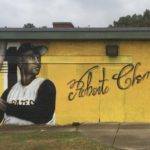
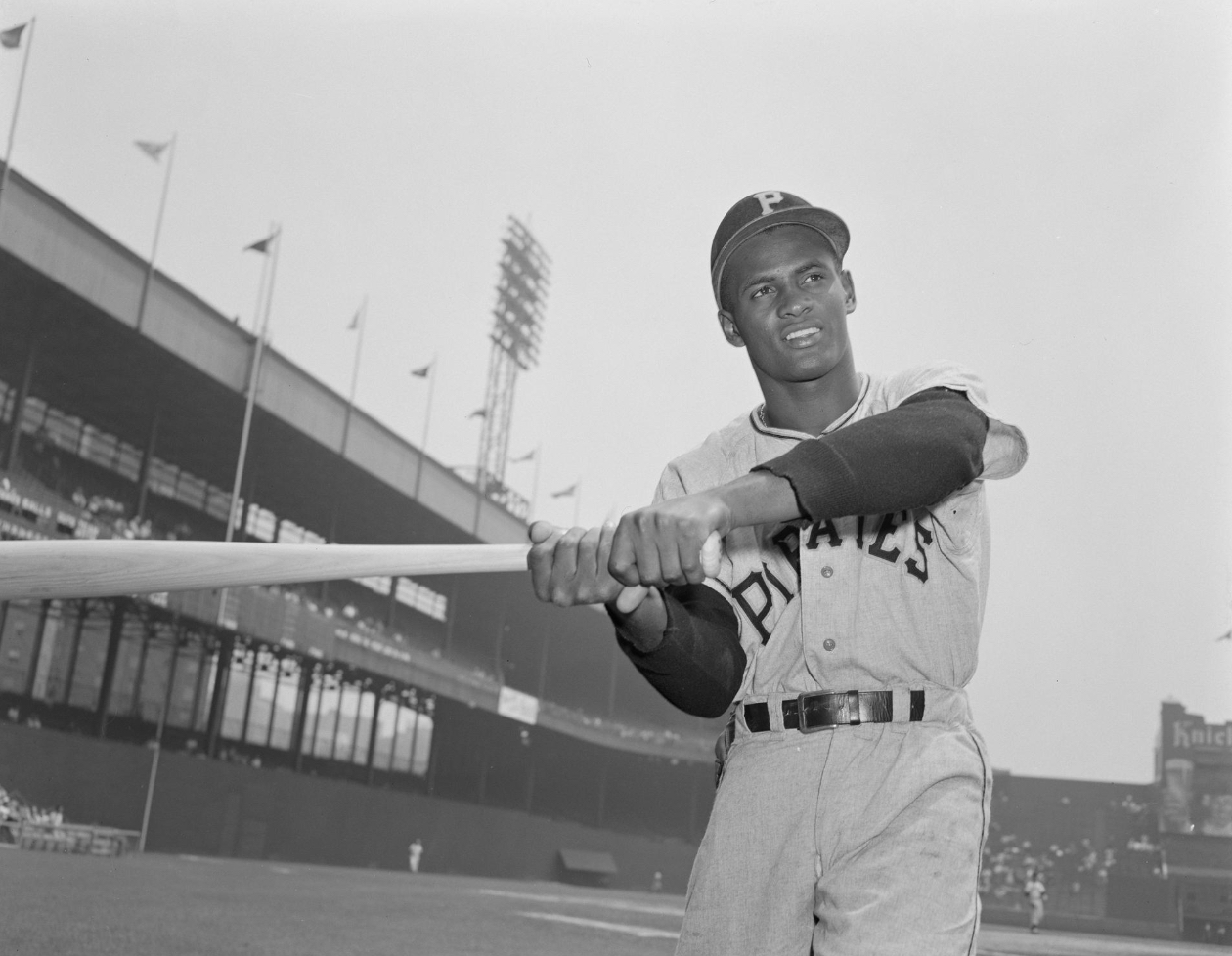
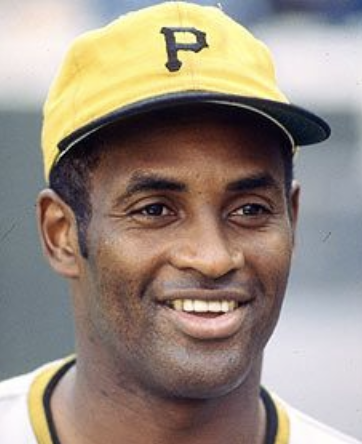
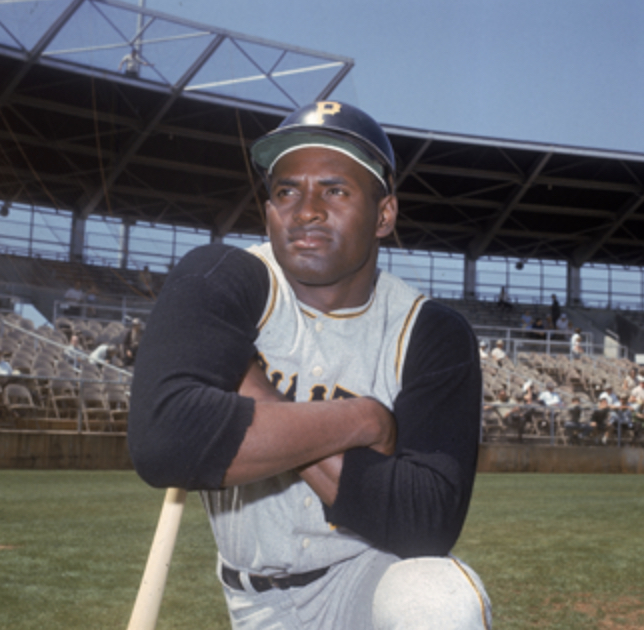
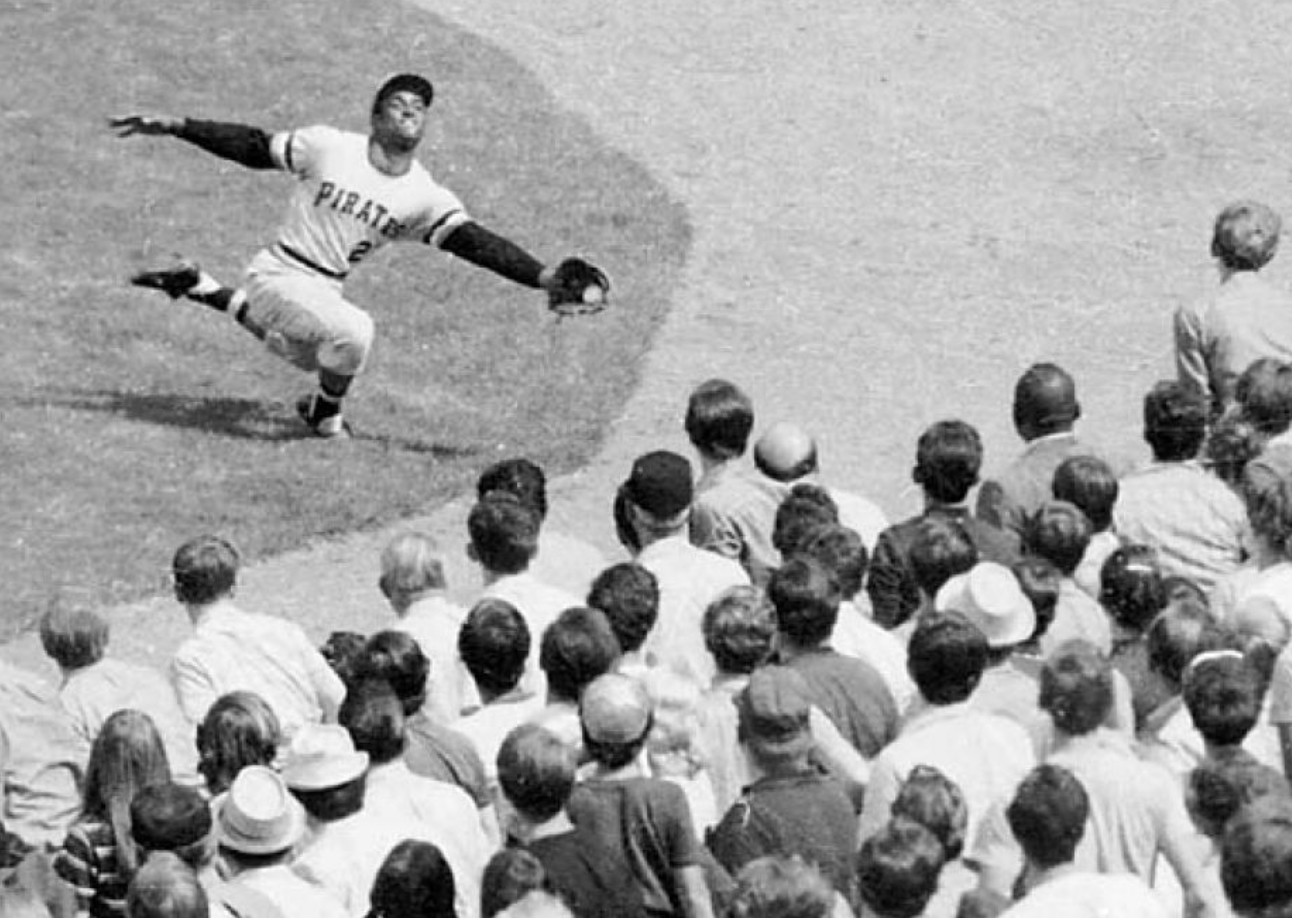
Roberto Clemente Mural at Hartford’s Colt Park

On November 1, 2018, a new mural commemorating the legendary Pittsburgh Pirates right fielder, Roberto Clemente. was completed at Hartford’s Colt Park. Artist, Corey Payne of West Hartford, painted the mural to resemble Clemente’s 1968 Topps baseball card. The project was sponsored by RiseUP, a community support and wellness organization who partnered with the Friends of Colt Park and their Roberto Clemente Celebration Committee. As an important figure in Puerto Rican history, the community in Hartford has also named the Colt Park’s main softball field after Clemente.

While in Pittsburgh for the entirety of his career, Clemente’s baseball career ranks among the best of all time. He was a 5-tool player who dominated his era. In addition to the Most Valuable Player Award, Clemente received 12 Gold Glove Awards, 4 National League batting titles, 12 All-Star Game selections and 2 World Series Championships,. He also achieved the rare feat of recording 3,000 hits. Perhaps the highlight of his career came in 1971, when he earned the World Series MVP Award for his performance against the heavily favored Baltimore Orioles. Clemente batted .414, hit two home runs, and turned in several standout defensive plays to lead the Pirates to one of the most surprising results in World Series history.

There’s also the record of Roberto Clemente the humanitarian. It is written in cornerstones of schools, hospitals, and other public buildings, inscribed on monuments and statues, struck on coins, imprinted on collectibles and book covers — it is simply his name, Roberto Clemente — evidence of his impact beyond baseball. Clemente became known for his philanthropy and his fierce pride in his Puerto Rican heritage. He had unusual capacity to bear a much larger identity—not just for Puerto Rico but for all of Latin America. It was a responsibility he embraced with dignity and admirable grace. He saw his career in baseball as a way to help Latin Americans, especially underprivileged Puerto Ricans, make their lives better.

“Always, they said Babe Ruth was the best there was. They said you’d really have to be something to be like Babe Ruth. But Babe Ruth was an American player. What we needed was a Puerto Rican player they could say that about, someone to look up to and try to equal.”

– Roberto Clemente
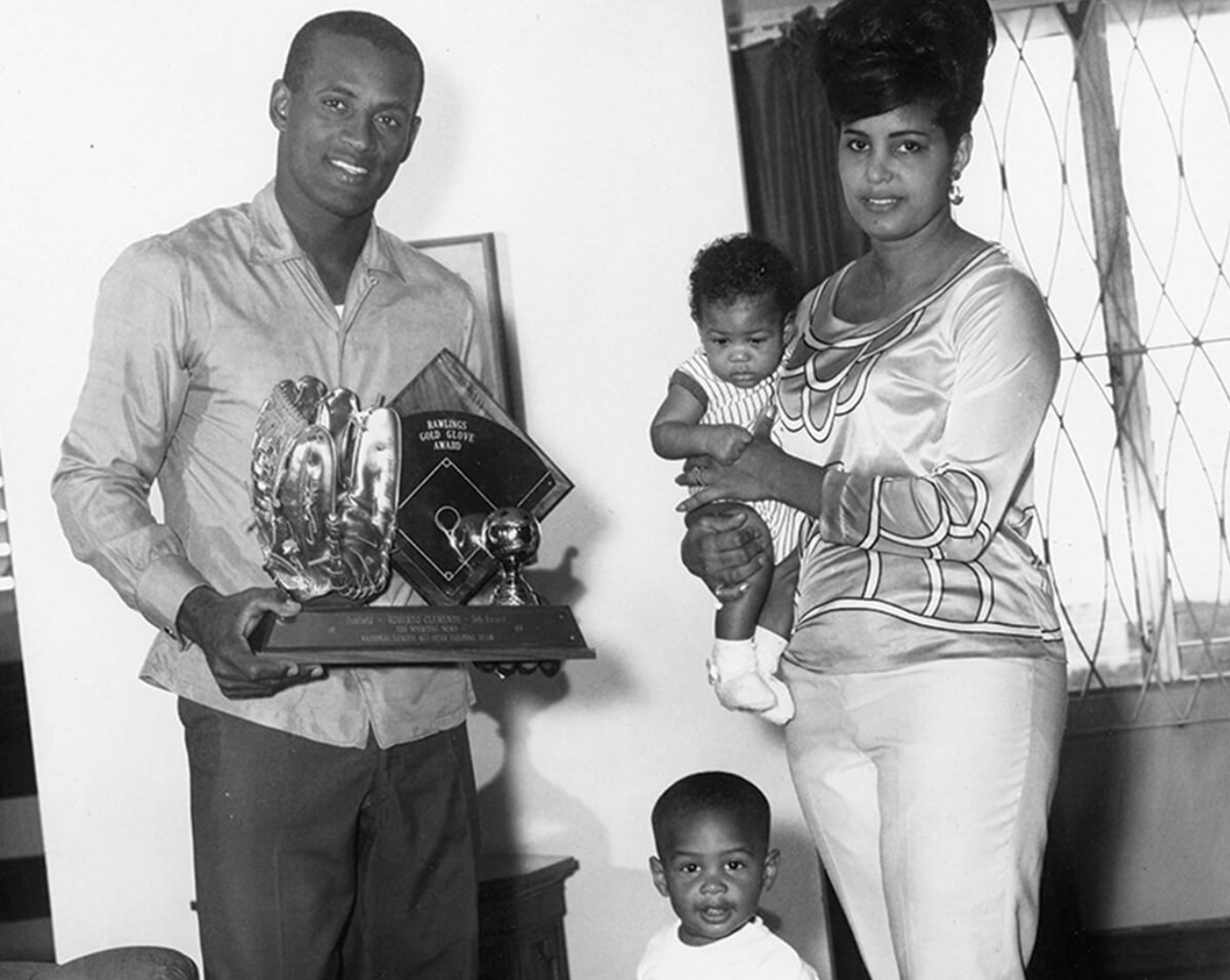
Clemente with his family, 1970.

Clemente’s philanthropy was not calculated to gain public or private recognition. He simply wanted to help people in need. For some, his generosity was financial; with others he freely shared his chiropractic knowledge — learned as a result of his own back injury in 1954; and for many others, particularly children, Clemente’s kindness came as free lessons in the game of baseball. Clemente always cared about children. Despite his busy schedule, he made time to hold baseball clinics for kids, especially for those from low-income families. He dreamed of building a “Sports City” where Puerto Rican youth would have access to baseball facilities, coaching, and teaching. It was another way of working towards a healthier, happier, Puerto Rico.

“Everyone knows I’ve been struggling all my life. I believe that every human being is equal, but one has to fight hard all the time to maintain that equality.”

– Roberto Clemente
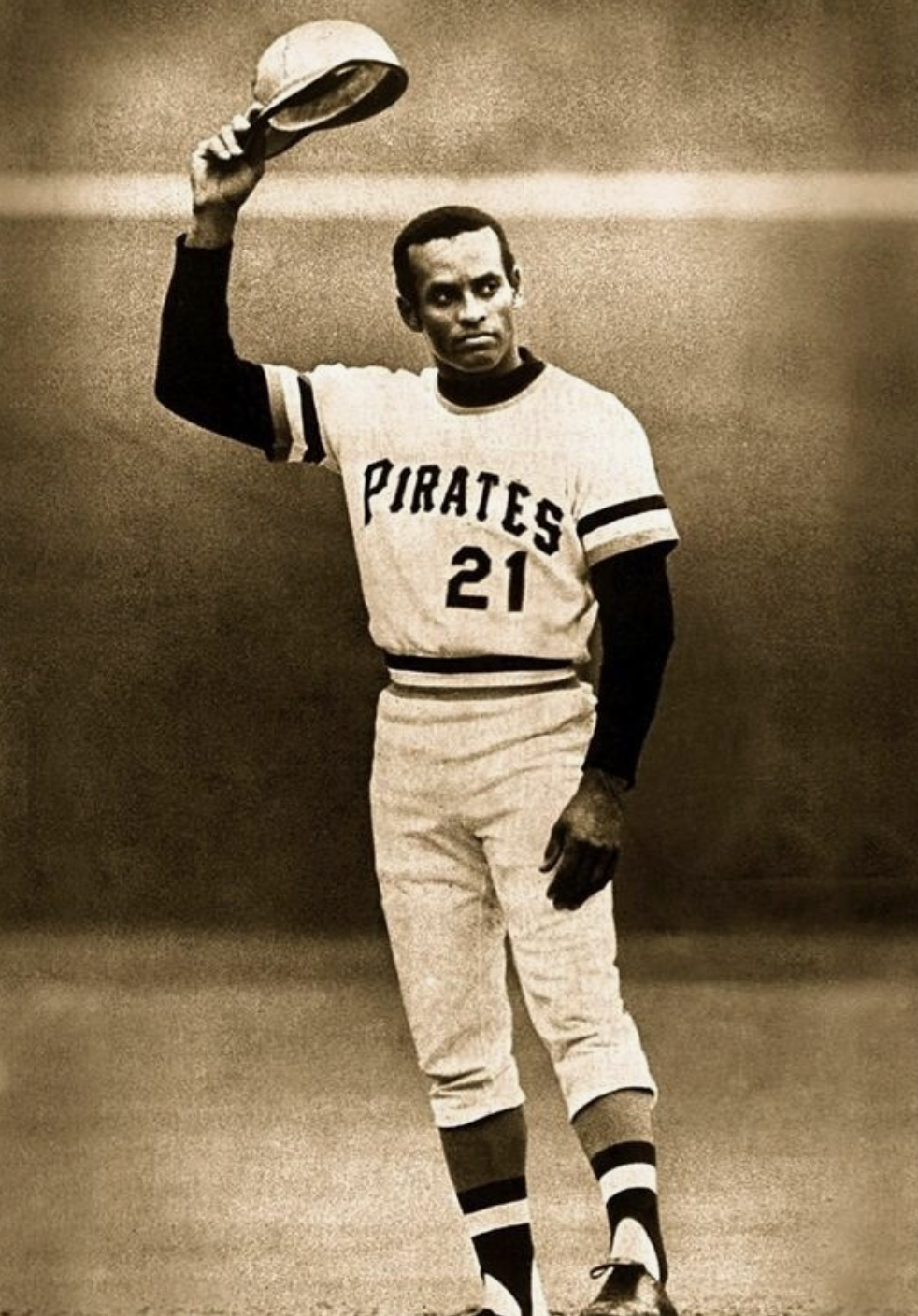
Clemente tips his cap after hitting his 3000th career hit, 1972.
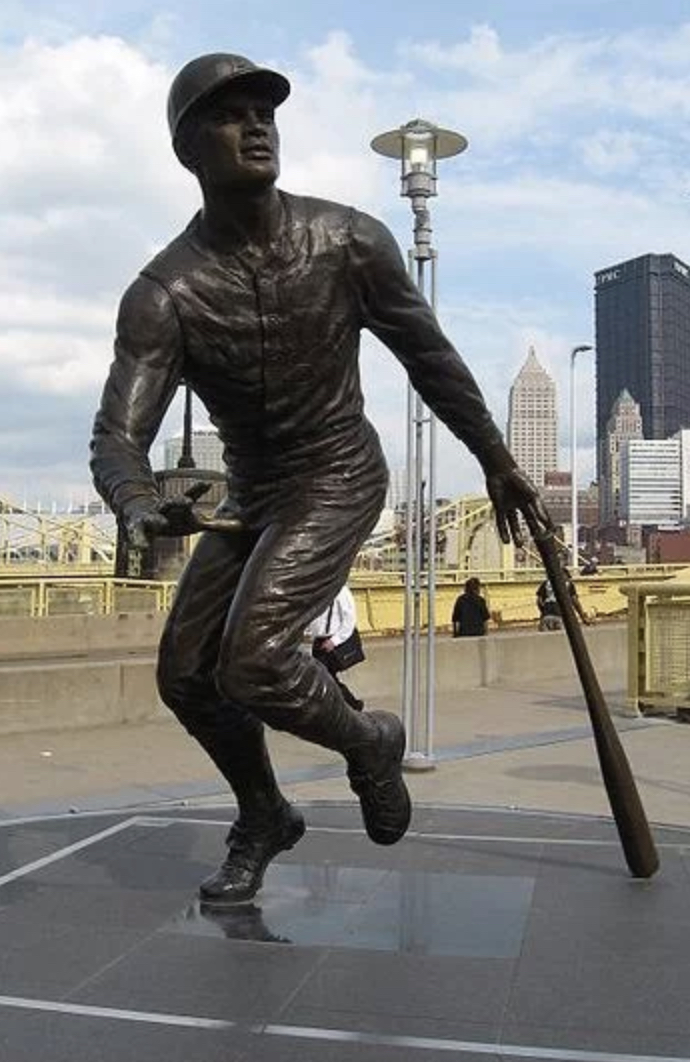
One of three exquisite statues erected outside of PNC Park, Roberto Clemente stands between the Center Field entrance and the Roberto Clemente Bridge.

Along with being inducted into the Baseball Hall of Fame in 1973, Clemente earned the following awards from Major League Baseball:

1960 Player of the Month Award

1961 Gold Glove Award, National League Outfielders

1961 Silver Bat Award (Bud Hillerich Award)

1962 Gold Glove Award, National League Outfielders

1963 Gold Glove Award, National League Outfielders

1964 Gold Glove Award, National League Outfielders

1964 Silver Bat Award (Bud Hillerich Award)

1965 Gold Glove Award, National League Outfielders

1965 Silver Bat Award (Bud Hillerich Award)

1966 Gold Glove Award, National League Outfielders

1966 Most Valuable Player Award

1966 Sporting News Player of the Year Award

1967 Gold Glove Award, National League Outfielders

1967 Player of the Month Award

1967 Silver Bat Award (Bud Hillerich Award)

1968 Gold Glove Award, National League Outfielders

1969 Gold Glove Award, National League Outfielders

1969 Player of the Month Award

1970 Gold Glove Award, National League Outfielders

1971 Gold Glove Award, National League Outfielders

1971 The Babe Ruth Award (World Series MVP)

1971 World Series Most Valuable Player Award

1972 Gold Glove Award, National League Outfielders

2002 Frank Slocum Big B.A.T. Award

2003 Presidential Medal of Freedom

2006 Commissioner’s Historic Achievement Award


Source: Beyond Baseball: The Life of Roberto Clemente

GHTBL Alumni Enter Hartford Public Hall of Fame

Among the inductees: Ed Skehan, 100 year old World War II Veteran.

On Sunday, November 4, 2018, a select group of former Hartford Twilight ballplayers were inducted into the Hartford Public High School Hall of Fame. Three of the four inductees are members of the GHTBL Hall of Fame joining three other GHTBL/HPHS Hall of Fame crossovers: MLB-alum Pete Naktenis, Johnny Dione, and Pete Sala.: 

Ed Skehan’s Amateur Baseball Career
– 1935 to 1937, Hartford Public High School.
– 1936, Lincoln Dairy, Hartford Twilight League.
– 1936, Prospect Tavern, East Hartford Twilight League.
– 1937 to 1941, St. Lawrence O’Toole, Catholic League.
– 1937, East Hartford Red Sox, East Hartford Twilight League.
– 1938, Pope Park Drug, Keene Senior Twilight League.
– 1941, Conrose All-Stars, East Hartford Twilight League.
– 1942, Finasts, East Hartford Twilight League.
– 1943, Owen’s All-Stars, East Hartford Twilight League.
– 1944, Joe Laing’s Spartans, a Hartford Twilight team turned semi-pro club based in Colt Park.
– 1948 to 1950, Hartford Fire Department.
– 1985, Inducted to GHTBL Hall of Fame (Gold Glove Division).

Edward Skehan (100 years old), class of 1937, was an outfielder on conference championship baseball teams at Hartford Public High School. In a game against LaSalette, Skehan led off with a home run and contributed two hits in the 8 to 4 win over the crosstown team. He would have many other multi-hit games and he played any position where HPHS Hall of Fame Coach Jimmy Woodworth needed him. Skehan became a utility player but would later find his niche at first base.

Ed Skehan turns 100 years old, 2018.

After high school, Skehan attended Hartford State Technical College, graduating in 1939. Skehan played amateur baseball for over 20 years in multiple local leagues. Most notable were the Greater Hartford Twilight League and the East Hartford Twilight League. He was a perennial all-star, a .300 hitter, and an outstanding defensive first baseman. 

Life was disrupted with the onset of World War II and soon Skehan was in the U.S. Army. He served from 1943 to 1946 as a Combat Engineer and spent two years in the European Theater.  He is a veteran of the Battle of the Bulge, a key turning point to facilitating the end of the war in Europe. 

In 1946, Skehan became a full-time employee at the City of Hartford Fire Department after working as a part-time firefighter in previous years. He would serve as a Hartford firefighter for 25 years.  While in the department he played on their highly competitive baseball and bowling teams. 

In 2017, at the age of 99, Ed Skehan was the guest of honor at the GHTBL’s Camp Courant Kids Day at Dunkin’ Donuts Park.  The entire Skehan family celebrated their patriarch that day as Ed threw out the ceremonial first pitch.

Ed Skehan throws out first pitch at Camp Courant Kids Day at Dunkin’ Donuts Park, 2017.

Jack Hines
– On the 1958 Robinson Builders team in the GHTBL.
– Played for the Riley Redlegs in the GHTBL from 1959 to 1961.
– 1962 Ames Construction team in the GHTBL.
– Manager of the 1963 Herb’s Sports Shop team in the GHTBL.   
– Manager of the Hartford entry into the Connecticut Summer Collegiate Baseball League.
– Manager of the 1965 Royal McBee team in the GHTBL. 
– Inducted to GHTBL Hall of Fame in 1988.

Jack Hines, Hartford Public High School class of 1956, played on the varsity baseball and basketball teams.  In baseball, he was catcher and team captain. He caught HPHS Hall of Fame pitcher and minor leaguer, Pete Sala.  Jack was behind the plate in Sala’s 10 inning 1-0 shutout and win over New Britain and their flamethrower Steve Dalkowski.  His leadership helped the Owls to the City championship in 1956. In basketball he was on solid teams that were City Champs his junior and senior years.  

Jack Hines, Riley Redlegs accepts Hartford Twilight League trophy, 1959.

Jack played basketball at Central Connecticut State University after high school.  He began a long career in the Greater Hartford Twilight League, most notably as a manager.  In 1988 he was inducted into the GHTBL Hall of Fame.

Jack was involved in amateur athletics in Bristol for many years.  He also currently serves as the President of the Bristol Sports Hall of Fame after serving as executive director and a board member. He authored the Bristol Sports Hall of Fame scholar–athlete ceremony that is named in his honor. In 2017 Jack Hines was inducted into the Bristol Sports Hall of Fame. Jack was also a founding Board member of the Hartford Public High School Athletic Hall of Fame.

Jack has received the Bristol Boys & Girls Club Humanitarian award and the Bristol Tramps Chuck McCarthy award in 2008. Jack Hines also received an honorary degree from Tunxis Community College, the first the school ever granted. 

Jack Hines of Bristol, Connecticut.

Bill Wishinsky
– Hartford Insurance Group from 1969 to 1974
– Herb’s Sports Shop player-manager from 1975 to 1992.
– Inducted to GHTBL Hall of Fame in 1995.

Bill Wishinsky, class of 1967, was multi sport star, playing baseball and football.  In baseball he was one of Hartford Public’s greatest baseball players ever. He was an outstanding pitcher, but also a great hitter on strong teams in the mid 1960’s.  

In baseball, he lettered all four years. He was the winning pitcher in 19 games which is believed to be a school record. As a freshman he beat East Hartford 1-0 and struck out 8 batters for his first career win. Highlights of his sophomore year were beating Hall for his 5th win of the season and against Bulkeley, in a 7-2 win, he drove in 5 runs. 

His junior year was the winning pitcher in eight games. In a game against East Hartford he was the winning pitcher, had three hits, including a home run.  In a win over New London he had 5 hits, 2 of which were triples.

Bill Wishinksy

Some highlights of his senior year were five more wins as a pitcher.  He pitched 12 shutout innings against Norwich in a 0-0 tie. Bill was the winning pitcher in a 3-1 besting of Bulkeley and had 3 hits and a rbi. In another win over Fitch he collected three hits and drove in five runs. He was the winning pitcher over Bulkeley (4-3) to clinch the city title and tie for the CDC crown. He hit .438 as a senior.

Wishinsky also played football and was a solid fullback and outstanding punter. His punting was key in an 8-6 win over rival Bulkeley in 1965.

Bill Wishinsky served in the military as a Marine.  He had a short stint in the minor leagues before returning home and embarking on a long career in the Greater Hartford Twilight League.  He was a fixture playing and managing for Herbs Sports Shop. He won the league batting title in 1974.  He was inducted in the Twilight League Hall of Fame in 1995.

Bill Wishinsky (born: 1949 – passed away: 2017). 

Hartford Courant article on Bill Wishinsky, 1990.

Jake Fournier

– On the Society for Savings team in the GHTBL from 1991 to 1992
– On the Newman Lincoln-Mercury team in the GHTBL from 1993 to 1996 led by manager, Gene Johnson.
– Player for KGA in the GHTBL from 1999 to 2002 and later player-manager from 2003 to 2004.
– Player-manager of Bill’s Sport Shop in the GHTBL from 2005 to 2007.
– Player-manager of RMR Construction in the GHTBL from 2008 to 2010.
– Played part-time for the Ferguson Waterworks team in the GHTBL from 2012 to 2013. 
– Fournier made his final appearance in 2015 in a GHTBL game with the Ulbrich Clippers.

Jake Fournier, class of 1990, was a versatile athlete playing multiple positions and competing in four sports during his time at Hartford Public. He earned at total of seven varsity letters.

In football, as a senior, Fournier played tight end and led the team in receiving and was also the punter, averaging over 40 yards per kick. He also threw an 82-yard option for a TD to tie South Windsor. Fournier was part of the group that helped transition Hartford Public football from the tough years in the 1980’s back to being a state power in the 1990’s.  Fournier lettered two years in basketball on strong teams that were city and conference champions in 1990 with an 18-4 record.

In baseball, Fournier earned a varsity letter three times and was team captain twice.  He was named All-CCC after his Junior and Senior season.  The HPHS baseball team made the state tournament his Sophomore year.

Jake Fournier hit a grand slam for Newman Lincoln Mercury of the GHTBL, 1994.

Fournier was the valedictorian of his class and was accepted at Yale University. While at Yale he played baseball as a walk on for two years.  In his Senior year, he earned the starting catcher spot and had an outstanding season.  He hit .301 and led the team in walks as Yale won the Ivy League championship.

After college Fournier explored professional baseball opportunities but decided to move to Portland, Oregon.  While there he met his future wife and played in very competitive amateur baseball leagues while on the west coast. He moved home to Connecticut in 1998 and continued his amateur baseball career as a key player for manager and leader in the the GHTBL. 

Fournier has coached his son’s team in Mayor Mike’s Little League in Hartford for the past five years. He has also has coached basketball locally in a travel league. Congratulations to Jake and the entire Fournier family! 

Jake Fournier of Hartford, Connecticut.

When Babe Ruth Barnstormed Greater Hartford

A young George Herman “Babe” Ruth visited the Greater Hartford area of Connecticut, to play baseball on multiple occasions. Like many big leaguers of his time, Ruth barnstormed the nation to earn additional pay. When he first visited the Constitution State in the fall of 1918, Ruth was a 23 year old starting pitcher for the Boston Red Sox. He had won more games than any left-handed pitcher in the previous four seasons. During that stretch, he compiled a 2.28 earned run average and a .650 winning percentage. His phenomenal achievements and large physical traits gave him instant appeal.

Ruth warming up at the 1918 World Series.

Ruth’s first appearance in Connecticut came after the 1918 World Series wherein the Red Sox defeated the Chicago Cubs. A victorious Ruth pitched 29 ⅔ scoreless innings (a mark not broken until Whitey Ford recorded 33 ⅔ innings in 1961). Attending the World Series was James H. Clarkin, sole proprietor of the Hartford Senators of the Eastern League. Clarkin tried to recruit both teams to play an exhibition game in Hartford benefiting American soldiers fighting in World War I. When his offer was declined Clarkin managed to land Babe Ruth instead.

Ruth and Boston Red Sox win 1918 World Series.

When Connecticut baseball fans received reports of Ruth’s arrival, they were clamoring to see him in action. Days after winning his second World Series, he appeared in several exhibition games throughout the state. His initial stop was in New Haven at Lighthouse Point Baseball Park. Ruth played first base for the semi-pro New Haven Colonials. He slugged a home run in a 5 to 1 loss against the Cuban Stars made up of players from the Negro Leagues.

Hartford Courant, September, 15, 1918.

The next evening, on Saturday, September 14, 1918, Ruth departed from New Haven and arrived in Hartford. He attracted large crowds of people hoping to meet the budding superstar. He was driven into the city by Manager Curtis Gillette of the semi-pro Hartford Poli’s baseball club to lavish accommodations at Hotel Bond on Asylum Street. The Hartford Poli’s were known as one of the “fastest” clubs in New England. The next day, Ruth joined the Poli’s on the Hartford’s top-notch diamond at Wethersfield Avenue Grounds.

Hotel Bond, Hartford, Connecticut.

On Sunday, September 15, 1918, Babe Ruth and the Hartford Poli’s opposed the Fisk Red Tops of Chicopee, Massachusetts. While pitching and batting third, he recorded two hits including a double off the “Bull Durham” tobacco sign on the center field wall. Ruth also threw a complete game shutout, allowed 4 hits and led the Poli’s to a 1-0 victory. He beat his Red Sox counterpart, Dutch Leonard who guest starred on the mound for the Fisk Red Tops. Another Red Sox teammate, Sam Agnew played catcher for the Poli’s and drove in the game’s only run. Ruth and the gang entertained a Hartford crowd of more than 5,000, earning $350 for his appearance.

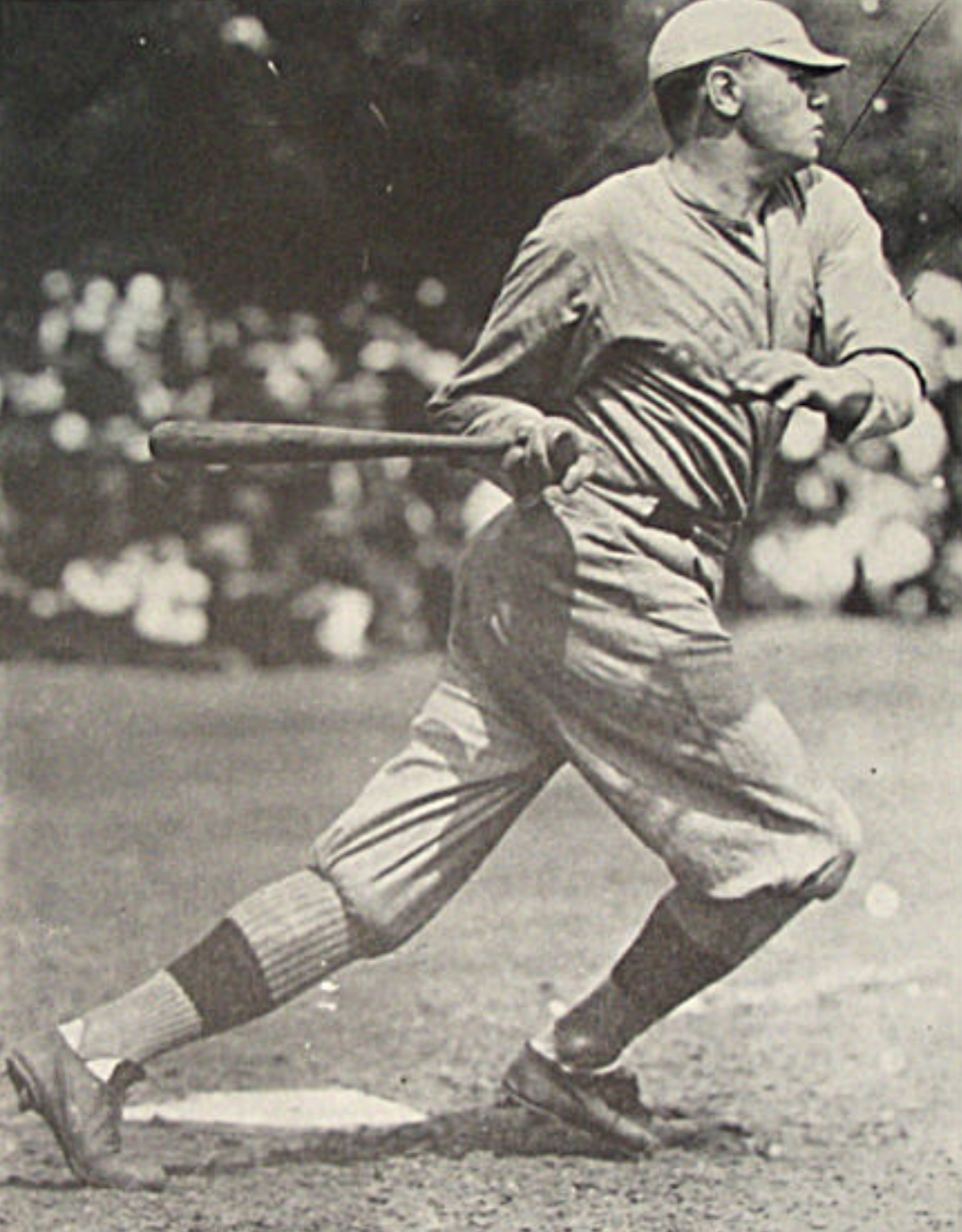
Babe Ruth, Boston Red Sox, 1918.

A week later, Ruth once again played at the Wethersfield Avenue Grounds for the Hartford Poli’s in a doubleheader. In the opening game, the Poli’s went head to head with the Pratt & Whitney Aircraft company nine. Five Major Leaguers including Ruth appeared that day. Ruth again was starting pitcher and hit third in the lineup. Even though he pitched well, Ruth was out-dueled by his Red Sox teammate and Pratt & Whitney guest star, “Bullet” Joe Bush who won the game by a score of 1 to 0.

Babe Ruth and “Bullet” Joe Bush, Boston Red Sox, 1918.

In the second game of the doubleheader, Ruth and the Poli’s faced an army base nine from Fort Slocum near New Rochelle, New York. Ray Fisher, former Hartford Senator turned New York Yankees ace mowed down Poli batters. The Fort Slocum nine beat the Poli’s by a score of 4 to 1. Ruth played first base, hit a single and scored the Poli’s lone run. A crowd of about 3,000 people were in attendance for this rare occasion; a doubleheader featuring Babe Ruth in Hartford.

Ray Fisher, New York Yankees, 1916.

The Babe must have enjoyed stopping over in Connecticut, because in autumn of the following year, he came back. This time he brought his Boston Red Sox teammates to Muzzy Field in Bristol, Connecticut, where Ruth would set a new record. On September 21, 1919, he played first base and hit fourth for the Red Sox versus Bristol’s semi-pro juggernaut, the New Departure Endees. The team was sponsored by New Departure, a division of General Motors, and a manufacturer of ball bearings for automobiles, planes, ships and military equipment.

Babe Ruth & Eddie Goodridge of New Departure, Muzzy Field, 1919.

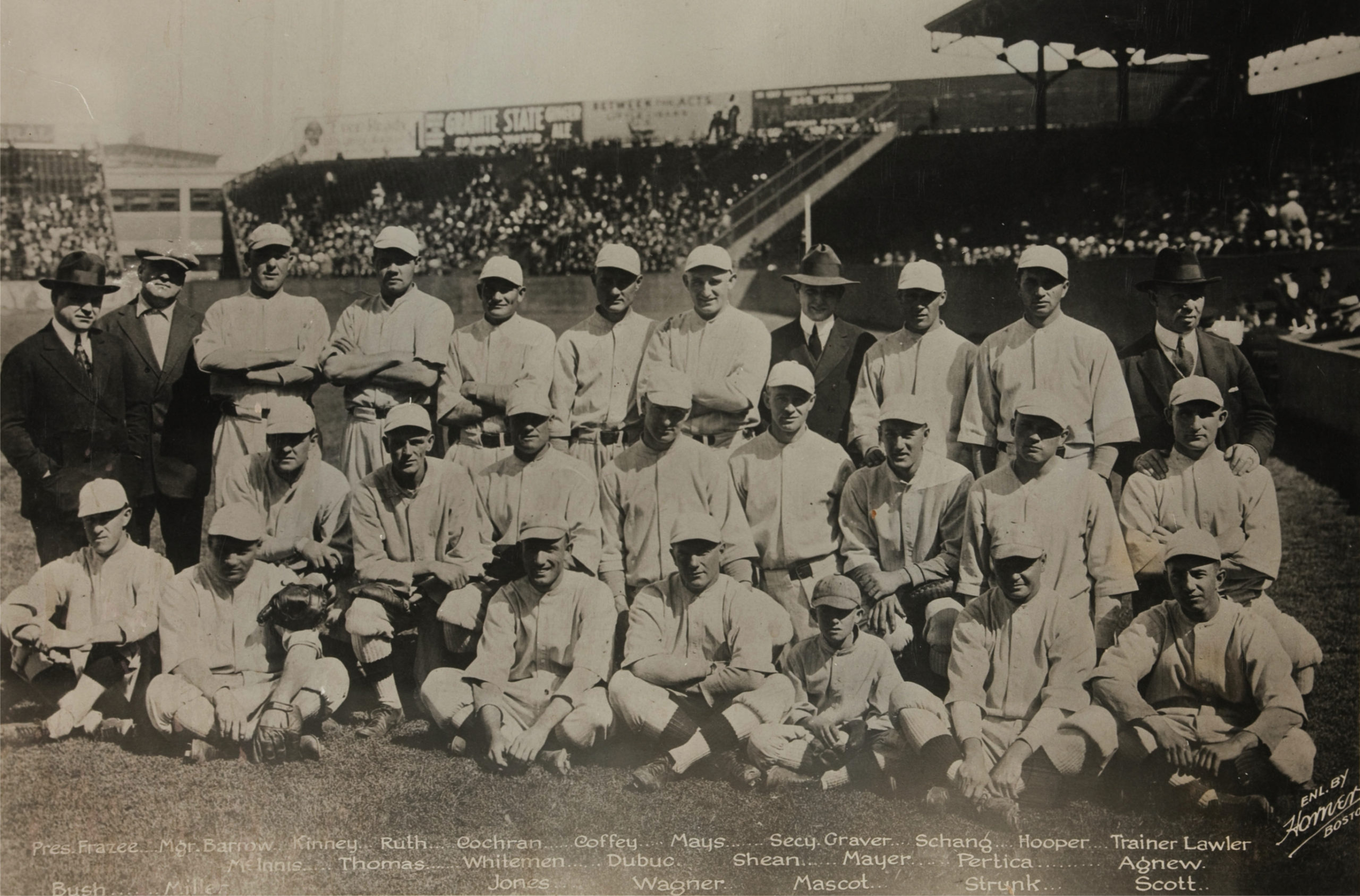
Also on the field for the Red Sox was Hall of Fame outfielder, Harry Hooper who had two hits and a run on the day. Though it was Babe Ruth who stole the show. “All eyes were pointed at the famous baseball mauler,” according to the Hartford Courant when he blasted the first ever home run at Muzzy Field. Hooper was on first base when the Babe connected with a pitch thrown by New Departure’s Freddie Rieger, a star pitcher for the Pittsfield team in the Eastern League. Ruth’s homer sailed over the right field fence as 5,000 onlookers cheered in adulation. The Red Sox won by a score of 6 to 2 over New Departure. The game would be remembered as Connecticut’s most thrilling sporting event of the year.

Babe Ruth and Lester Sigourney, New Departure Manager, Muzzy Field, 1919.
L to R: DeWitt Page, Babe Ruth and Judge William J. Malone, Muzzy Field, 1919.
New Departure Baseball Club, 1919.
Babe Ruth marker at Muzzy Field, 2014.

While the rest of the Red Sox went home, Ruth stay in Connecticut. He played first base in another game with the Hartford Poli’s on September 28, 1919 at Poli Field in East Hartford. The Poli’s were met by the New Britain Pioneers, the Hardware City’s top ball club. Mayor of Hartford, Richard J. Kinsella threw out the game’s ceremonial first pitch and posed for a photograph with Ruth. The Babe hit two balls over the right field fence but was only allowed one base for each long ball due to a “short porch” ground rule. Earlier that day he had hit a batting practice homer said to be struck over 500 feet. The Poli’s shutout the Pioneers 3 to 0 before a crowd of more than 6,000 fans.

Babe Ruth and Mayor Richard J. Kinsella, Hartford, Connecticut, 1919.
Spectators at Poli Field, East Hartford, Connecticut, 1919.

A few months later, on January 5, 1920, Babe Ruth was purchased by the New York Yankees from the Red Sox for $125,000 cash and $300,000 in loans. His services were sold after Ruth refused to return to the Red Sox at a salary of $10,000 per year. The Yankees struck the deal of the century. Ruth went on to smash his own home run record with an astounding 54 dingers in the 1920 season, while batting at .376 clip. New York only made Ruth bigger, better and in higher demand to fans across the country. Fortunately for cranks in Connecticut, the Babe kept coming back to play for the Poli’s.

Hartford Courant, January 6, 1920.

By the end of 1920, the New York Yankees were runner-ups in the American League behind the Cleveland Indians. As the season came to a close, Manager Gillette of Hartford persuaded Ruth to join the Poli’s once more. Again they faced the New Departure squad at Muzzy Field. On October 2, 1920, The Babe hit clean up for the Poli’s, played every position except pitcher and went 4 for 4 with 3 singles and a double. Nonetheless, New Departure shutout the Poli’s 7 to 0 thanks to crafty pitching from Gus Helfrich, a minor league spitball hurler from the New York State League. Extra trains and trolleys were scheduled to Bristol that Saturday afternoon, allowing 10,000 fans a chance to see Babe Ruth one last time at Muzzy Field.

Babe Ruth coming to Muzzy Field, Bristol, Connecticut, 1920.
Babe Ruth at Muzzy Field, Bristol, Connecticut, 1920.

Connecticut’s amateur and semi-pro baseball clubs regularly hosted Babe Ruth and in return, he left a long-lasting impression. In Greater Hartford and beyond, Ruth earned baseball thousands of new fans. He barnstormed throughout the East Coast in grand fashion, ushering in the home run era and baseball’s Golden Age (1920 to 1960). He retired in 1935 after leading the New York Yankees to their first 4 World Series wins. Ten years later, Babe Ruth took the final at bat of his career when he appeared in an exhibition game for the Savitt Gems at Hartford’s Bulkeley Stadium.

Babe Ruth on the Savitt Gems, Hartford, Connecticut, 1945.

Sources

  1. Hartford Courant Database on Newspapers.com

Related

  1. The “Babe Comes to Hartford by Ronald Bolin
Subscribe to our YouTube channel

New Management in the Twilight League

3 new managers assume roles in East Hartford, Meriden and Middletown.

Record-Journal Expos – Charlie Hesseltine, Manager
– Drafted by the Texas Rangers in the 42nd round of the 2003 MLB June Amateur Draft as a left-handed pitcher.
– In 2006, he signed with the Atlantic City Surf of the Atlantic League.
– He pitched for 3 more Atlantic League teams including the Bridgeport Bluefish in 2008.
– Meriden, CT, resident and member of the United Brotherhood of Carpenters.

East Hartford Jets – Taylor Kosakowski, Manager
– Right-handed relief pitcher at Central Connecticut State University (’06-’08) with 72 K’s and 35 walks over 96 innings.
– Veteran of GHTBL and player-manager of the Ulbrich Clippers in 2018.
– Public school psychologist in Hebron, CT.

Middletown Outlaws – Christian Budzik, Manager
– Shortstop at Eastern Connecticut State University (’14-’17) with a .354 OBP and 77 hits in 121 games.
– He was part of the Cromwell High School baseball team who won the 2012 CIAC Class S championship.
– Special education teacher in Cromwell, CT.

Bob Ferguson & the Saga of the Hartford Dark Blues


Robert Ferguson (1845-1894) was tough, as Hartford would come to find out. In the summer of 1873, Nat Hicks, catcher for the New York Mutuals, foolishly argued with Ferguson during a game in which Old Fergy was acting as umpire. After a few moments of name-calling and insults, Ferguson, whose no-nonsense umpiring philosophy was, “make ‘em play ball and keep their mouths shut,” grabbed a bat and ended the dispute with one swing, fracturing Hicks’s arm in the process.

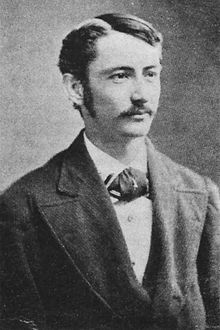
Bob “Death to Flying Things” Ferguson, 17-year professional player-manager signed as a new member of the Chicago White Stockings, 1878.

Hartford came to know Bob Ferguson in 1875 when he signed a contract to manage and play third base for the city’s entry in the National Association (1871-1875), America’s first professional baseball league. The Hartford Dark Blues* had entered the league the previous year under the auspices of Ben Douglas Jr. This was the 24-year-old Middletown native’s second attempt at running a professional team in Connecticut. His first had failed miserably in 1872 when the Middletown Mansfields couldn’t survive a full season in the National Association. Finding it impossible to draw sufficient support in a city of only 11,000 residents, Douglas was forced to disband the team in mid-August with empty coffers and a dismal 5-19 record.

Hartford Courant excerpt, 1874.

Aware that the National Association still desired a club between New York and Boston so visiting teams could layover midway, Douglas was convinced that Hartford was the answer. Early in 1874, he gathered many of Hartford’s most prominent businessmen, including Morgan Bulkeley, to sell them on the benefits of professional baseball in Hartford. They responded enthusiastically, pledging $5,000 toward the new ballclub. Douglas was named corresponding secretary for the club, an important and time-consuming job in the days before formalized league schedules and telephones. Gershom B. Hubbell was elected president. Hubbell’s baseball experience included running the amateur Charter Oaks, Hartford’s first organized club, which he founded in 1862. The Charter Oaks were state champions from 1865-1867, before ceasing operations in 1870.

Morgan G. Bulkeley named first President of the National League in 1876 and later became Mayor of Hartford then Governor and United States Senator of Connecticut, 1915 (c.)

The Dark Blues, whose uniform stockings were just that, finished next to last in their first professional season. Worse than their failure on the diamond, the players mortified Hartford’s more genteel residents with their lack of decorum off the field. Much of the blame for the team’s embarrassing conduct fell on captain and center fielder, Lipman Pike. In these early days of baseball, the team captain’s responsibilities were similar to that of today’s manager. Pike took a laissez-faire approach to managing, convening few practices and, as the Hartford Post reported in July 1874, allowing his men to “cling to their love for strong drink, for a round of pleasure at the hours when they should be abed.”

Prominent figures in the Greater Hartford area invested in the new professional ballclub who would compete in the National Association (1874-1875).

Intent on remedying the shameful situation, the Dark Blues turned to Ferguson, the most authoritarian captain in the game. In addition to being an excellent fielder and solid hitter, Ferguson was an upstanding citizen. At a time when not many ballplayers could say the same, he was a teetotaler and scrupulously honest. However, he was also a domineering, dictatorial captain with a violent streak. Al Spalding, the premier pitcher of the era, who went on to found the sporting goods empire that continues to bear his name, described Ferguson’s leadership in his memoirs, America’s National Game: “He was no master of the arts of finesse. He had no tact. He knew nothing of the subtle science of handling men by strategy rather than by force.”

Hartford batting averages (per game), 1874.

Ferguson surely improved discipline on the Dark Blues ballclub in his first season in Hartford, but his overbearing ways proved divisive and the team quickly gained a reputation for bickering, or “growling” in the 19th-century vernacular. When the team was losing, or even winning, he found it difficult to keep his temper in check. As the Chicago Tribune reported, if anyone on the Hartford nine committed an error, “Ferguson [would] swear until everything looks blue.” He was particularly rough on second baseman Jack Burdock, who on more than one occasion heard his captain publicly threaten “to ram his fist down Burdock’s throat.”

Chicago vs. Hartfords at Hartford Base Ball Grounds, 1875.

Some players tolerated their captain’s tyrannical leadership. Others, however, refused to comply. Whenever they found themselves the subject of Ferguson’s bullying, shortstop Tom Carey and center fielder Jack Remsen did not hesitate to yell back. Burdock and pitcher Arthur Cummings, on the other hand, often sulked; they sometimes feigned sickness and played half-heartedly, or not at all. Despite a talented squad and a record of 54 wins and 28 losses, the Dark Blues’ lack of unity confined them to second place behind Spalding’s Boston Red Stockings. (These particular Red Stockings were the forerunners of the Braves who played in Boston through the 1952 season before moving to Milwaukee and then Atlanta.)

1875 Hartford Dark Blues
L to R, Standing: Jack Remsen, Tom York, Candy Cummings, Tommy Bond and Bill Harbridge. Seated: Doug Allison, Everett Mills, Bob Ferguson, Tom Carey and Jack Burdock.

In 1876, Hartford became the smallest of eight cities invited to join a new, more financially stable professional baseball league. The National League (the same National League in which today’s New York Mets play) was organized to address the myriad economic and gambling problems that led to the demise of the National Association after the 1875 season. Morgan Bulkeley, who had become president of the Dark Blues in 1875 after Hubbell retired from the post, was named the league’s first president. Hartford harbored high hopes of taking the reform league’s inaugural pennant. Al Spalding, now a member of the Chicago White Stockings, later to become the Chicago Cubs, told the Chicago Tribune that Hartford would “no doubt share some of the laurels, and it would really astonish some Chicagoans could they hear the manner in which this club is extolled in Hartford…The support given the club by the people of Hartford is of the most liberal character considering the size of the city, and is from the very best class of people.”

1876 Hartford Dark Blues
L to R: Back Row: Tommy Bond and Candy Cummings. Middle Row: John Burdock, Ed Mills, Bob Ferguson, Bill Harbridge and Tom York. Front Row: Dick Hingham, Doug Allison, Tom Carey, and Jack Remsen.

The Dark Blues debuted in the National League on April 27 in Brooklyn against the New York Mutuals. Through four innings, they played like the championship contender they were supposed to be, as star pitcher Tommy Bond limited the Mutuals to one hit and Hartford built a 3-0 lead. Things went awry in the fifth, however, as the Dark Blues committed four successive errors and the Mutuals waltzed to an 8-3 victory. The club righted itself with nine consecutive victories before the powerful White Stockings arrived in town to play a three-game series at the Hartford Base Ball Grounds, the Dark Blues’ state-of-the-art ballpark located at the corner of Hendricxsen Avenue and Wyllys Street, adjacent to the still-standing Church of the Good Shepherd.

Hartford Base Ball Grounds, former home field of the Dark Blues, 1877.

An 800-seat pavilion behind home plate provided a covered seating area for stockholders and season ticket holders. On top of the pavilion was a tower with a domed roof and seating for the scorers, a telegraph operator, and one reporter from each city paper. Underneath were spacious clubrooms for each team. Tiered general admission bleachers stretched down the foul lines, and there was plenty of room for patrons’ carriages to be parked deep in the outfield, as was the custom. An eight-foot fence surrounded the entire grounds, which held approximately 9,000 fans. Gambling and the sale of liquor were strictly prohibited.

Against the favored White Stockings, whom the Hartford Times labeled “dignified, pompous, [and] conceited,” Hartford took two of the three games. These wins moved the Dark Blues into sole possession of second place, just two victories behind Chicago. Until 1882, wins, not winning percentage, determined the league standings. This was an important distinction since in these sometimes disorganized early days of baseball, teams often played an uneven number of games. Despite their success on the diamond, the Dark Blues struggled financially as a depressed economy shrank attendance.

Hartford Base Ball Headquarters, Main Street Hartford, Connecticut, 1876.

Searching for ways to increase revenue, Morgan Bulkeley engaged in a fierce battle with Hartford’s telegraph operators, who during home games posted inning-by-inning scores on bulletin boards outside their offices. Believing this practice was keeping paying customers away from the actual games, Bulkeley banned Western Union operators from the grounds. The telegraph company refused to comply, however, and sent in an employee whose job was to record the result of each inning on a piece of paper and toss it over the fence to the operator stationed outside. When Bulkeley saw this, he commanded the young boy who was acting as a runner between the telegraph company’s “inside man” and the telegraph operator outside the park to disregard the note. Ignoring the command, not the note, the boy took off on a dead run. Bulkeley ordered the police to seize him, but the young lad eluded the slow-footed officers, frustrating the team president.

Morgan G. Bulkeley, also nicknamed the Crowbar Governor, was the first President of the National League.

Back on the field, Hartford hosted three games against the hapless Cincinnati Red Stockings, losers of twelve straight. Ferguson took this opportunity to rest Tommy Bond and give his diminutive backup, Arthur “Candy” Cummings, some work. In his National League debut, Cummings stifled Cincinnati on a three-hitter as Hartford won 6-0. This masterful performance prompted Ferguson to proclaim, “God never gave him any size, but he is the Candy.”2 The nickname “Candy,” which meant “best” in 19th-century slang, stuck for the rest of Cummings’s life. Candy Cummings was later enshrined in the National Baseball Hall of Fame, mostly to honor his claim as the inventor of the curveball.

Arthur “Candy” Cummings  is credited as the inventor of the curveball, 1872.
Arthur “Candy” Cummings is credited as the inventor of the curveball, 1872.

Even when his team was playing well, Ferguson’s temper continued to get the better of his judgment, leading him to holler at his players frequently during games. These public rebukes fueled a simmering dissension that was just waiting for something to ignite it. The trigger came in the form of an 8-2 loss in the second game of the Cincinnati series. This humiliating defeat at the hands of a club that would finish the season with just 9 wins outraged the Hartford Times:

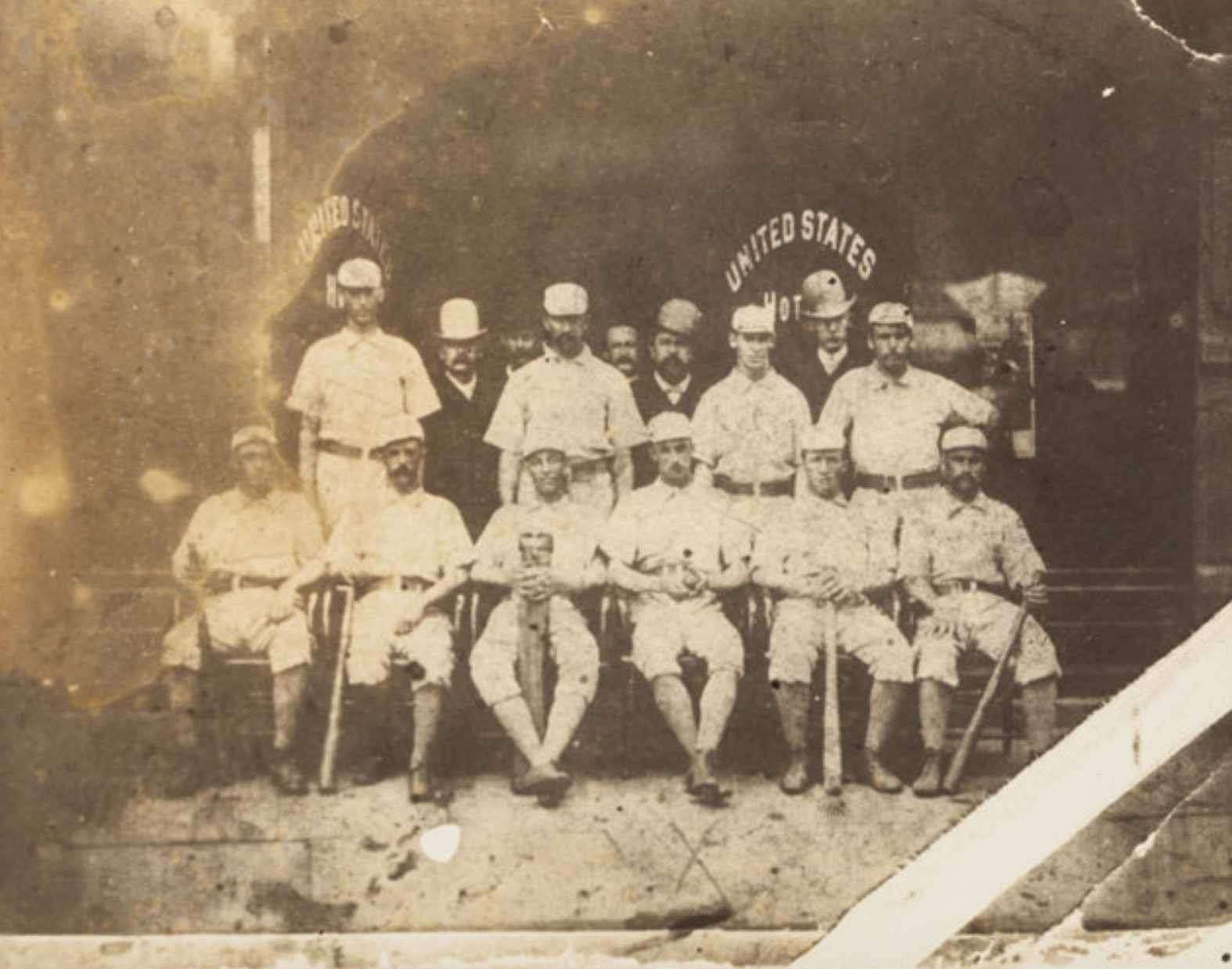
The Hartford Base Ball Club pose outside the United States Hotel, Hartford, Connecticut, 1876.

There is something rotten in the Hartford club… These players are paid big salaries and they have no business to let petty jealousies and bickerings interfere with their play. If one of them gets his ‘nose out of joint’ over some real or imaginary grievance, he shows his spite by mugging on the ball field. One complains because Captain Ferguson talks too much and refuses to play his game; another declares he won’t back up Cummings; and somebody else, likely enough, is miffed because the hands of the South Church clock are not clapped every time he makes a passable catch. The men are hired to play ball—not to play baby… [Emphasis in the original.]

Bob Ferguson, Captain and First Baseman of Hartford Dark Blues in a Troy Trojans uniform, 1879.

Although Boston Red Stockings’ manager Harry Wright had heard that “hardly two men in the Hartford nine are on speaking terms with all the others,” the club momentarily got past its growling to take the final game from Cincinnati. Over the next two weeks they reeled off six victories in a row thanks mainly to the spectacular pitching of Tommy Bond, who threw three shutouts and two one-hitters during this stretch. Realizing the immense value of Bond, Hartford quickly dropped the idea of signing a new pitcher and contracted him for the 1877 season. When word of Bond’s new contract hit the streets, the joy in Hartford was palpable.

Harry Wright, Player-Manager of the Boston Red Stockings, 1874.

As Hartford departed on a long western tour, the Cincinnati debacle was a distant memory. After stops in Louisville and Cincinnati, the club arrived in Chicago (Chicago and St. Louis were the furthermost western cities in the National League until 1958 when the Brooklyn Dodgers and New York Giants moved to Los Angeles and San Francisco, respectively) having won 12 of its last 13 games. The first game between the two pennant contenders was on Independence Day, which in 1876 was celebrated with extra fervor since it marked the nation’s centennial.

A raucous crowd of 12,000 was on hand, some having purchased grandstand seats at triple the standard 50-cent charge. The rowdy throng loudly cheered the White Stockings’ arrival, but some fans went overboard, igniting firecrackers and even firing pistols. The game itself featured no offensive fireworks as Tommy Bond and Al Spalding both tossed shutouts through six innings. In the seventh, Hartford pushed across the game’s only runs, scoring three times off Spalding with the help of two critical Chicago errors.

f, Pitcher, Hartford Dark Blues, 1876.

Back in Hartford, 1,000 people had gathered at the Dark Blues’ headquarters awaiting word from Chicago. The scores were received three innings at a time. The first two bulletins, covering six innings, showed all zeros. The final dispatch ignited a grand celebration. After sending a congratulatory note to Ferguson, a giddy Morgan Bulkeley provided a sumptuous spread in the clubrooms and ordered a load of fireworks. Later in the evening, Hartford celebrated the Dark Blues’ victory and the nation’s hundredth birthday with a grand display of pyrotechnics launched from the club’s headquarters and the Hartford Times office.

1876 Chicago White Stockings

Two days later, with 2,000 supporters assembled outside the Dark Blues’ headquarters, weak hitting Jack Remsen led off the second game in Chicago with a rare home run, giving Hartford a lead they would never relinquish. Tommy Bond’s curveballs were especially effective on this day, even fooling the umpire, who often called them strikes even when they broke well out of the strike zone. The final score was 6-2. The Dark Blues were now just a single victory from sweeping the mighty White Stockings and taking a share of first place. To prevent this, Chicago’s captain Al Spalding sent versatile first baseman Cal McVey to the pitcher’s box to stop the surging Hartford nine. McVey came through against Hartford just as he had earlier in the year, holding them scoreless for the first seven innings as Chicago cruised to an easy 9-3 victory.

Al Spalding, Pitcher, Boston Red Stockings, 1875.

Despite the loss, the Dark Blues remained upbeat as they traveled to St. Louis, poised to continue their winning ways. Rumors, backed by the flow of gambling money, were rampant that the Browns, hoping to keep the pennant away from Chicago, would lie down for Hartford. This hardly proved to be true, however, as St. Louis swept the series behind the fabulous pitching of George Washington Bradley who hurled three shutouts, one of which was the National League’s first no-hitter. The three losses to St. Louis quickly erased the benefit of the hard-earned victories in Chicago. When they returned home, the Dark Blues weren’t in first place as the Hartford Courant had predicted during the road trip. In fact, they weren’t even alone in second place, as St. Louis had drawn even. The excitement that had enveloped the city three weeks earlier had completely evaporated. In a startling display of apathy, only 200 people bothered to attend the Dark Blues’ first home game in nearly five weeks.

1876 St. Louis Brown Stockings with George Washington Bradley (standing, center).

As Hartford continued to fall off Chicago’s pace, more trouble arose. In a 13-4 loss to the Boston Red Stockings on August 19, Tommy Bond struggled while Bob Ferguson committed several errors at third base. After the game, the Hartford Courant reported that the star pitcher had accused his manager of “crooked work.” Bond’s allegation was shocking. A charge of throwing games was serious business, especially when leveled against Ferguson, who had a spotless reputation when it came to gambling. In America’s National Game Spalding said of him, “Robert Ferguson was… a man of sterling integrity and splendid courage. He knew all about the iniquitous practices which had become attached to the game as barnacles to a ship, and he was sincerely desirous of eradicating them… Could it have been possible to eliminate gambling by physical demonstrations, Robert Ferguson would have cleared the Base Ball atmosphere of one of its most unsanitary conditions at that time.”

Ferguson wrote to the Hartford Times, denying all charges, pronouncing “each and every one false in every particular” and saying they were made with “a malicious purpose.” A day later, in the same newspaper, Bond recanted his statement, saying his charges “were entirely unfounded, and made in a moment of excitement, and I cheerfully acknowledge the wrong I have done both to the club and its manager, and make this the only reparation in my power.” Despite the casual retraction, the ill will between the two men lingered until finally Bond informed Bulkeley that he wouldn’t play with Hartford so long as Ferguson was captain. Forced to choose between the two adversaries, Bulkeley annulled the remaining portion of Bond’s 1876 contract and released him from his 1877 commitment. Incredibly, less than three weeks after the initial charge, all connections between the Hartfords and their brilliant pitcher were severed.

On the field, Ferguson quickly deployed Candy Cummings in the pitcher’s box. Despite pitching well enough to keep Hartford on the margin of the race for the pennant, he couldn’t prevent the White Stockings from taking the championship with a 7-6 victory over Hartford on September 26. Hartford closed the season with a nine-game winning streak that gave them second place over St. Louis. Several Hartford players produced excellent individual statistics. In his abbreviated season, Bond amassed 45 complete games, 31 wins, and a 1.68 earned run average (ERA). Cummings posted 16 victories, a 1.67 ERA, and 5 shutouts. Right fielder Richard Higham put together a 24-game hitting streak while batting .327 and tying for the league lead with 21 doubles.

These personal accomplishments notwithstanding, lack of team harmony was the root cause of the Dark Blues’ failure to capture the pennant. With Ferguson’s constant badgering and the resulting backlash from his men, Hartford’s record suffered. Still, if the Dark Blues could have just managed to beat part-time pitcher Cal McVey, the National League pennant would have landed in Hartford. The strong Iowan, who started only six games for Chicago, won all four of his starts against Hartford. These victories provided the winning margin for the White Stockings who finished just five victories ahead of the Hartfords.

An excerpt in the Hartford Courant on March 8, 1877 about the team relocating to Brooklyn.

The 1876 season was the Dark Blues’ last in Hartford. In hopes of better gate receipts, Morgan Bulkeley moved his club to Brooklyn for the 1877 season, forever removing Hartford’s status as a major league baseball city. The club’s finances were no better in its new location and the club was dropped from the National League at the end of the season. Bulkeley himself soon severed his ties with baseball. In 1879 he became head of Aetna (which his father had founded); a political career followed. He was elected mayor of Hartford, served four years as a controversial governor of Connecticut, and was a U.S. senator from 1905 to 1911. He died at age 84 in 1922. Robert Ferguson also managed the team in 1877. After the Dark Blues were disbanded he played for Chicago, Troy (New York), and Philadelphia, ending his career in 1883. He died in 1894 at age 49.

Since the Dark Blues’ departure after the 1876 season, only minor league clubs have called Hartford home, none since 1952. Only an active imagination, aided by a tour of the site of the old Hartford Base Ball Grounds, can rekindle the city’s brief major league days. The ballpark no longer exists, of course. In fact, even the corner of Wyllys Street and Hendricxsen Avenue has disappeared as both streets have been reconfigured. But nestled against the grounds of the Church of the Good Shepherd and its grand companion building, the Caldwell Colt Memorial Parish House, is a beautiful expanse of green lawn that was once the Dark Blues’ home.

The Church of the Good Shepherd overlooked the Hartford Base Ball Grounds.
A plaque commemorating the site of the old Hartford Base Ball Grounds, Hartford, 2013.
Hartford Base Ball Grounds home plate marker.
Hartford Base Ball Grounds second base marker.
Hartford Base Ball Grounds first base marker.
Hartford Base Ball Grounds third base marker.

Standing in the shadow of these two grand monuments to Hartford’s past evokes memories of an era when baseball was young and Hartford was a major player in its development. One can picture opposing batters vainly flailing at the curveballs tossed by Bond and Cummings, the “hurrahing” of Hartford resident Mark Twain who often attended games, and captain Bob Ferguson booming out his usual admonition, “Have a care, boys!” and threatening to exact physical punishment if they did not. Despite the interceding decades, one can almost see the players’ dark blue stockings and hear the growling that once filled those hallowed grounds.

Mark Twain (Samuel Clemens) would regularly attend Hartford Dark Blues games and took notes of the action on his personal stationary.

David Arcidiacono, a member of the Society for American Baseball Research (SABR) lives in East Hampton, Connecticut. This article is adapted from his new book, Grace, Grit, and Growling: The Hartford Dark Blues Base Ball Club, 1874-1877, which can be obtained from the author at Darcidiacono@snet.net or online at the Vintage Base Ball Factory Website:  www.vbbf.com.

*The Hartford Base Ball Club was the official name of the team during their era while “Hartford Dark Blues” was their nickname popularized by newspaper reports in the Hartford Times.

2018 GHTBL Annual Award Winners Announced

Twilight players honored for their standout seasons.

The top GHTBL players and the best team, the Vernon Orioles separated themselves from the competition this season.

Here are the 2018 GHTBL Award Winners:

Frank McCoy Award – Most Valuable Player – Mark DiTommaso, OF, Rainbow Graphics

Mike Liappes Award – Most Valuable Pitcher – Charlie Hessletine, P, Record-Journal Expos

Ray McKenna Award – Player of the Year – Jonathan Walter, OF, Record-Journal Expos

Rev. Thomas Campion Award – Outstanding Playoffs Hitter – Dan Trubia, 3B, Vernon Orioles 

Mike Abbruzzese Award – Outstanding Playoffs Pitcher – Paul Dougan, P, Vernon Orioles 

Hal Lewis Award – Most Versatile Player – A.J. Hendrickson, P/OF, Record-Journal Expos

Gene Johnson Award – Regular Season Batting Title – Jonathan Walter, OF, Record-Journal Expos

Ralph Giansanti Sr. Award – Stolen Base Winner – Jonathan Walter, OF, Record-Journal Expos

Jack Repass Award – Gold Glove – Jeff Criscuolo, INF, Ulbrich Clippers

James Gallagher Award – Rookie of the Year – Jake Petrozza, OF, South Windsor Phillies 

Jake Banks Trophy – Regular Season Champion – Vernon Orioles, Jack Ceppetelli, Manager

Jack Rose Trophy – Playoff Champion – Vernon Orioles, Jack Ceppetelli, Manager

President’s Note:

Our successful 2018 season was a great milestone for the GHTBL. This past summer marked the 90th year of the league as the premier amateur league in Connecticut. The league hosted games at some of the best fields and stadiums in state and matriculated 3 players into the professional ranks. The running tally of GHTBL players who have played professional baseball is now 320.

Next season, the GHTBL will seek to strengthen its current franchises and will explore opportunities for expansion. The league most recently had an Executive Committee meeting and has scheduled another meeting for November 4th at 5 PM in East Hartford. 

– Bill Holowaty, President

Visit our Instagram account @GHTBL for the latest updates and follow our blog “The Bat and Ball” on GHTBL.org for Greater Hartford’s historic baseball stories and tidbits.

The Bat and Ball, Discovered at State Library

In 1990, at the Connecticut State Library in Hartford, a local historian named Linda Gradofsky discovered an original copy of the world’s first known baseball periodical, The Bat and Ball. The May 1, 1867 publication “Devoted to our National Game” was the “Second Season” of the series. Published without photographs or advertisements, the paper was written for Hartford’s earliest baseball fans. Columns included season previews of clubs from around the nation as well as scores from recent games played.

In 1990, Linda Gradofsky, a local historian, unearthed an original copy of “The Bat and Ball,” the world’s first known baseball periodical, at the Connecticut State Library in Hartford. Dated May 1, 1867, this discovered issue was part of the “Second Season” series and was dedicated to “Our National Game.” The publication was tailored for Hartford’s early baseball enthusiasts. It featured columns with season previews of various national clubs and scores of recent games.

Hartford Courant, August 21, 1990.

“The Bat and Ball” was available on Hartford’s streets for five cents per copy, with an annual subscription of fourteen issues costing fifty cents. The publication covered “base ball” events across the nation during the post-Civil War period, including a section on cricket. At this time, baseball was still a burgeoning sport, rapidly gaining popularity. The demand for detailed sports coverage was growing, and Hartford was at the forefront of sports journalism.

And yet, somehow, the author(s) are unknown to this day. “The Bat and Ball” is still somewhat of a mystery. Here’s the full publication of the Second Season—No. 1:

The Bat and Ball, page 1, May 1, 1867.
The Bat and Ball, page 2, May 1, 1867.
The Bat and Ball, page 3, May 1, 1867.
The Bat and Ball, page 4, May 1, 1867.

“The Bat and Ball” Debuts in Hartford

During the post-Civil War era, base ball was helping to unify the United States. With increasing popularity, fans demanded closer coverage. In 1866, The Bat and Ball became the first known baseball periodical. The publication sold for 5 cents a copy on the streets of Hartford, Connecticut. For subscribers, 14 issues were delivered throughout the year for 50 cents. The publication enlightened readers about local and national matches and a few columns on the game of cricket.

The Bat and Ball mentioned in the Hartford Courant, 1866.

A rare copy of The Bat and Ball was uncovered in 1990 at the Connecticut State Library. Linda Grodofsky, the reference and government documents librarian, said she found the issue on a shelf in a reading room among old newspapers. This rare copy of The Bat and Ball is preserved and stored in a secure area and available for visitors to view.

Hartford Courant excerpt, August 25, 1866.

Before the discovery of The Bat and Ball, historians acknowledged The Sporting News as the first periodical to feature baseball – debuting March 17, 1886. However Hartford’s The Bat and Ball preceded The Sporting News by twenty years. Authorship of The Bat and Ball is unknown because the periodical was written anonymously, though a possible author may have been Gershom B. Hubbell, President of the Hartford Base Ball Club and a telegraph operator for Western Union.

Hartford Courant excerpt, October 16, 1866.

The issue at the Connecticut State Library, dated May 1, 1867, was the paper’s Second Season—No. 1:.

”This season, which is now opening, bids fair to be one of the most exciting that our National Game is likely ever to know,” a story on page one of the four-page paper said, nine years before the first major league was formed. ”And it is well that it should be so, for there is no more worthy object of public attention now before the American people than this same national game.”

The Bat and Ball issue also outlined rules agreed upon by local base ball dignitaries:

Rules of the Connecticut Base Ball Player’s Association. 

1. All match games for the championship shall be played in accordance with the rules adopted by the National Convention. 

2. The season for play shall commence on the first day of May, and continue until the first day of November. 

3. All challenges shall be sent to the secretary of the club at the time holding the emblem. 

4. The champion club must be prepared to play within fifteen days after receipt of a challenge, provided that they be not required to play a game oftener than once in ten days, and shall play clubs in the order of the dates of their challenges, the champions being allowed choice of time, ground and ball for the first game, the challenging that for the second game; and the third game, if such game be necessary, shall be played upon neutral ground in the State, with a ball furnished by the cham­ pion club. In case of any dispute relative to grounds or rules, the difficulty shall be referred to the committee on rules and regulations, and their decision when given shall be final. 

5. The expenses of every champion game must be defrayed by the challenging club. 

7. No challenging club, being defeated, shall challenge again the same champions during the same season. 

8. The champions, being defeated, may chal­lenge immediately after the defeat, and be allowed a match in the order of their challenge. 

9. In case the champions shall change bands during the season, all outstanding challenges shall be assumed by the new champions. 

President – John A. Sterry of Norwich. 

Vice President – lst, Gersbom B. Hubbell of Hartford; 2d, S. M. Knevals of New Haven. 

Recording Secretary – R. E. Crane of Agallian Club, Middletown. 

Corresponding Secretary – Thomas M. Haven of Pequot Club, New London. 

Treasurer – Alexander Hawley of Bridgeport Club, Bridgeport.

At the time, baseball rules varied widely. This included clubs who used a different number of balls and strikes allowed to a ”striker” (batter). “The Bat and Ball” called for ”a uniform manner of playing.” Another column urged umpires to be more diligent to ensure that pitchers (who threw underhanded from a distance of 45 feet) tossed pitches where the striker, or batsman, wanted the pitched – a rule during the vintage days of ”base ball.”

View of Hartford, Connecticut, 1869.

Game rules of early base ball often resulted in high scores. A column in The Bat and Ball headed ”Match Games” reported on a game in San Francisco played on ”the birthday of the father of his country” (Feb. 22, 1867) in which the Eagles routed the Pacifics, 70-32.

Hartford Courant featurette on “The Bat and Ball”, August 21, 1990.

When Jimmie Foxx & the Philadelphia Athletics Came to Hartford

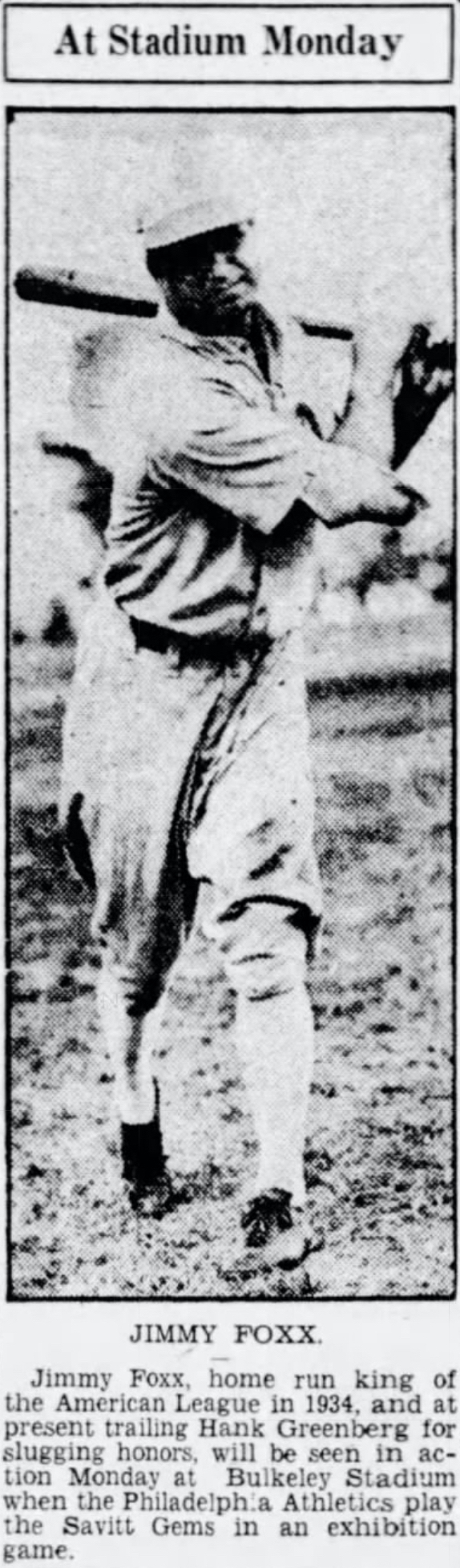
In 1933 and 1935 the American League powerhouse Philadelphia Athletics visited Hartford, Connecticut. The A’s were 2-time World Series champions, nicknamed the “Mackmen” after their manager Connie Mack. They came north to play exhibition games against Hartford’s semi-pro team, the Savitt Gems, comprised of guest starring professionals like Rabbit Maranville of the Boston Braves and local players such as Johnny Roser, Bob Cronin and Jigger Farrell. Jewelry store owner and philanthropist Bill Savitt organized the games. His Gems hosted the A’s before thousands of fans at Hartford’s Bulkeley Stadium. Leading the Mackmen was their slugging first baseman and Most Valuable Player, Jimmie Foxx.

Jimmie Foxx, First Baseman, Philadelphia Athletics, 1933.
Connie Mack, Manager, Philadelphia Athletics, 1933.
Bulkeley Stadium, Hartford, 1932.

When the Athletics first came to Hartford, James “Jimmie” Emory Foxx, nicknamed “Double X” and “The Beast” was baseball’s most coveted young star. Foxx led the majors in home runs during the 1932 and 1933 seasons. His power-hitting prowess made the A’s visit a highly anticipated event throughout Connecticut. The first exhibition game was scheduled when Connie Mack, who began his professional career in Hartford, accepted an invitation from Bill Savitt. Even though Mack was unable to attend the game, he telegraphed a lineup to the Hartford Courant in advance.

Jimmie Foxx, Philadelphia Athletics, 1933.
L to R: Max Bishop, Jimmie Foxx, Lefty Grove and Dib Williams, 1933.

On Thursday, June 15, 1933, Foxx and the Philadelphia Athletics arrived in Hartford on their day off. The A’s traveled by train but without their ace, Lefty Grove who had recently pitched. Connie Mack’s train was delayed, so he decided not to make the trip. Nevertheless, the Mackmen nearly shutout the Gems behind the pitching of “Big” Jim Peterson who threw a complete game. Jimmie Foxx was held to a single base hit on the day, but the A’s easily defeated the Gems by a score of 6 to 1. At summer’s end Foxx was baseball’s Triple Crown winner with 48 home runs, 163 RBI and a .356 batting average.

Hartford Courant excerpt, June 15, 1933.
Jimmie Foxx, Philadelphia Athletics, 1933.

A rematch at Bulkeley Stadium in Hartford occurred on September 23, 1935. Because Connie Mack was absent due to an illness, Jimmie Foxx assumed the role of A’s manager that evening. Foxx’s teammate Pinky Higgins went 2 for 4 at plate with a towering home run. A’s catcher and former Hartford Senators farm hand, Paul Richards smashed another homer. On the mound for the Gems was the former Red Sox lefty hurler Johnny Micheals who allowed 10 hits and 4 runs in 9 innings of work. Meanwhile, Philadelphia’s starting pitcher Bill Dietrich struggled against the Gems.

Jimmie Foxx, 1935.
Pinky Higgins and Eric McNain, Philadelphia Athletics, 1935.
A’s vs. Gems, Bulkeley Stadium, 1935.
Pinky Higgins, 1935.

By the end of two innings the Savitt Gems scored 5 runs on triples from Jigger Farrell and Johnny Michaels. To the everyone’s surprise, the Gems held the lead throughout the game. Michaels earned the win, mustered 3 hits at the plate and scored the deciding run. Hartford’s brotherly duo, Jigger and Tommy Farrell shined for the Gems, each collecting two hits. Hartford’s team upset Philadelphia’s world champions by a final tally of 6 runs to 4. The well-attended contest ended under the lights as Jimmie Foxx, who was held hitless on the night, made a rare two-inning appearance on the mound.

1935 Philadelphia Athletics
Hartford Courant excerpt, September 24, 1935.
Johnny Michaels, 1936.
Subscribe to our YouTube channel

GHTBL Seeks 4th Win Versus CTL at New Britain Stadium

All Star Game to be held on Sunday, August 19, 2018.

The 2018 GHTBL vs. CTL All Star Game will be played at New Britain Stadium on Sunday, August 19th at 8 PM under the lights. 

The game will take place immediately following the New Britain Bees vs. Long Island Ducks matchup at 5 PM.

The GHTBL All Star team will be selected at the end of the Regular Season. Representing players will seek to claim victory over the Connecticut Twilight League All Star team for the 4th straight game (4 of 4). The first All Star matchup between the two leagues was in 2015 and since then the game has showcased some of the best local ballplayers in the state of Connecticut.

We look forward to your attendance!
 – Tickets will be $10 per person
 – Free for kids 14 and under

August 3-11: Playoffs at Trinity College

Double-elimination tournament to be hosted at Trinity’s turf baseball facility in Hartford.

Games to be played on August 3, 4, 6, 7, 8, 9, 10, & 11 (if needed) at Trinity College, 300 Summit St, Hartford, CT 06106

– Tickets will be $10 per person at the gate for all fans.
– Players, Managers, League Officials, and Volunteers are free.
– A food truck will be in attendance to serve as concessions. 

Note to players and managers:
To be eligible for playoffs, players need 5 total appearances in 5 separate/individual games as either a position player or a pitcher. For example, 3 pitching appearances in 3 games and 2 appearances at First Base in 2 games equals a total of 5 appearances. 

GHTBL Raises $4,500 for CT Children’s Medical Center

The Hartford Yard Goats and Dunkin’ Donuts Park hosted the Twi-loop’s Charity Series.

The Greater Hartford Twilight Baseball League achieved the 2nd Annual Charity Series at Dunkin’ Donuts Park on Thursday, June 21 and Friday, June 22. 

8 teams made up of current and former college ballplayers as well as several ex-professionals competed under the lights. 

Adult fans paid $10 at the Main Gate and helped us raise $4,500 to be donated to Connecticut Children’s Medical Center in Hartford.

(Pictured above – L to R: Wes Ulbrich, GHTBL Secretary and Bill Holowaty, GHTBL President present a check to Nicholas Giampetruzzi of Connecticut Children’s Medical Center.)

Thank you to all of the friends, family, and fans who came out to the ballpark and we hope to see you again throughout the 2018 season and for next year’s Charity Series.

All the best,

Bill Holowaty
GHTBL President

Charity Series at Dunkin’ Donuts Park

4 GHTBL games to benefit Connecticut Children’s Medical Center to be held June 21 and 22.

June 21st and June 22nd – first pitch at 6:10 PM each night.

The GHTBL Charity Series will feature a pair of doubleheaders on back-to-back nights to raise funds for Connecticut Children’s Medical Center.

 South Windsor Phillies East Hartford Jets6:10 PM EDT 
06/21/18
 Rainbow Graphics Vernon Orioles8:00 PM EDT 
06/21/18
 People’s United Bank Middletown Outlaws6:10 PM EDT 
06/22/18
 Record-Journal Expos Ulbrich Clippers8:00 PM EDT 
06/22/18

Tickets are $10.00 per person; free entry for kids 14 and under.
Reserve tickets or pay at the Main Gate – 1214 Main Street, Hartford, CT 06103. Event open to the public; tickets valid for any and all games. 

CLICK HERE TO RESERVE TICKETS

Thank you to the Hartford Yard Goats for facilitating our stadium rental.

We’ll see you at the ballpark for this great cause!

Jack Patterson & Zac Susi Selected in MLB Draft

GHTBL Alumni matriculate to professional baseball.

Jack Patterson (Suffield, Conn.) – currently pitching for the Vernon Orioles selected by the Chicago Cubs in the 32nd round (968th overall)

High School: Suffield Academy
College: Bryant –After going 3-0 with a 3.41 ERA as a true freshman in 2014, Patterson missed most of 2015 and all of 2016 before returning to the diamond in 2016. What has followed is one of the most impressive two-year runs for a left-handed pitcher in program history.

Patterson went 4-0 with three saves and a 2.90 ERA as a redshirt junior before cementing himself as the best left-handed power pitcher in program history this spring. He became just the second pitcher in program history to strikeout 100+ batters in a single season and allowed just 75 hits in 82 innings on his way to Northeast Conference Pitcher of the Year honors. This spring, he recorded six quality starts, threw Bryant’s first nine-inning complete-game shutout since 2014 and struck out 10+ batters on four occasions.

Jack Patterson, Bryant Baseball, 2018.

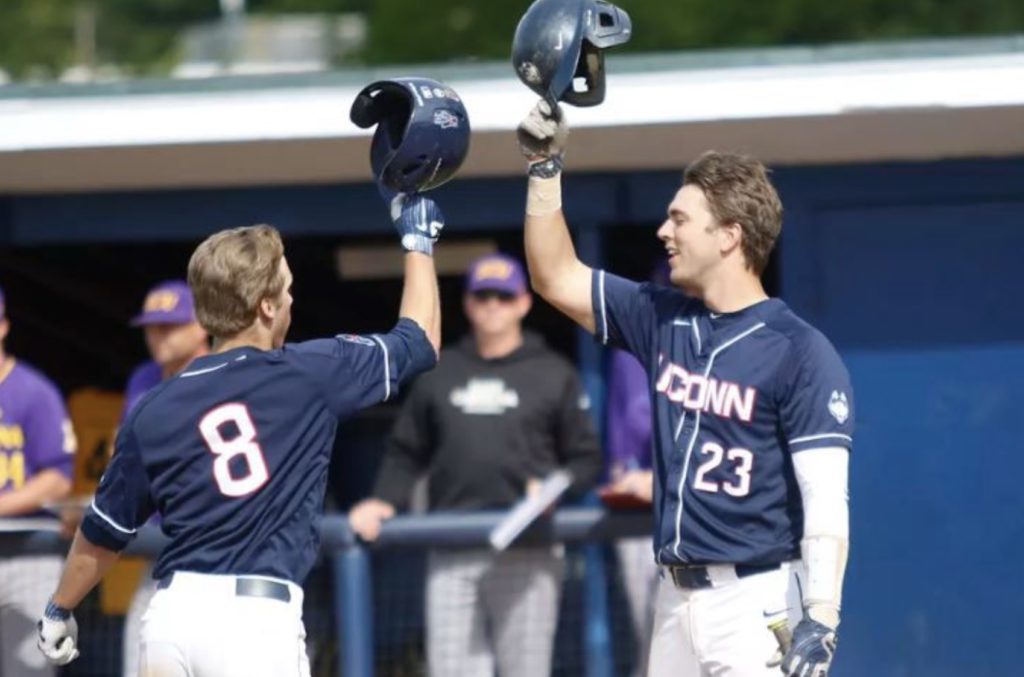
Zac Susi (Southington, Conn.) – former catcher for Rainbow Graphics franchise selected by the Pittsburgh Pirates in the 12th round (354th overall).

High School: Southington High
College: University of Connecticut – 
Susi, 21, has been a three-year starter at UConn since graduating Southington High in 2015, where the left-handed slugger was a two-time All-State backstop. He has been UConn’s primary catcher the last three seasons. He started 41 games as a freshman. As a sophomore, he hit .286 and started 56 games and was named to the Johnny Bench Award Watch List.

In 2017, Zac played 57 games and started 56 behind the plate as the Huskies primary catcher. He hit .286 on the year and was second on the team with 61 hits, nine doubles, two triples, two home runs and was second on the team with 40 RBI. Susi led the team with 27 walks and had a .362 on base percentage. He also had a team-leading 15 RBIs in the seventh inning or later. Behind the plate, he threw out 15 base runners attempting to steal.

Susi earned All-Star status with the Bourne Braves in the Cape Cod Baseball League. He played in 23 games and hit .276 with 20 hits, three doubles, three home runs, 10 RBIs and scored 12 runs. Zac is the son of John Susi, Head Baseball Coach at Western Connecticut State University and

Zac Susi (right), UConn Baseball, 2018.

Season to Feature the Top Venues in Connecticut

GHTBL’s 90th anniversary year to open on Tuesday, May 29, 2018.

President’s Note – Season Preview:

The GHTBL is set to open at 6 PM, Tuesday, May 29th in Vernon, CT at Frank McCoy Stadium at Henry Park in a matchup between 2017 champs, the Vernon Orioles versus the Playoff Tournament runner-ups, the Record-Journal Expos. An Opening Day ceremony with take place before first pitch. 

2018 marks the 90th year of the GHTBL and to celebrate this milestone, 8 franchises will enter the league to play a pure and fast brand of baseball that our league has been known for. GHTBL plays the game of baseball as it was intended to be played; hitting nine batters, using wood bats, and no video replays or pitch clocks.

Current and former college ballplayers as well as a several future and former professional players will take to the field to compete in 24 Regular Season games followed by our annual double elimination Playoff Tournament.

Throughout the 2018 Regular Season and Playoff Tournament our league has scheduled games to be played at best baseball fields in the Greater Hartford area. On Thursday, July 21 and 22 each GHTBL franchise will play a game at Dunkin’ Donuts Park in Hartford for a special Charity Series fundraiser for Connecticut Children’s Medical Center. Then the Ulbrich Clippers will host People’s United Bank at New Britain Stadium on Wednesday, July 25th.

From August 2-11, our Playoff Tournament will be held once again at Trinity College on their new turf ballpark. On Sunday, August 18th, we will host Connecticut Twilight League at New Britain Stadium for an All-Star game between our two leagues. 

Our 90th anniversary is turning out to be a highly anticipated year for the GHTBL and we’re pleased to have you be a part of it as a fan, players, parents, family and friends. 

All the best,

Bill Holowaty 
GHTBL President

Rainbow Graphics to Sponsor Oldest Twi Team

The franchise traces back to 1935, joining GHTBL in 1956.

Manchester, Connecticut – Rainbow Graphics of 118 Adams Street in Manchester owned by Fred Kask has become the sponsor of the former Marlborough Braves team who played their 2017 home games at West Road Memorial Field in Marlborough under the direction of their Player-ManagerMark DiTommaso. Mark will lead the newly named Rainbow Graphics ball club into the 2018 GHTBL Regular Season, carrying on an long held tradition.

Not only is the GHTBL in its 90th year of play this season, but this Manchester-based franchise also has its own extensive history:

Before Rainbow GraphicsMarlborough Braves, and Foss Insurance, heavy-hitting player-manager, Gene Johnson led the Newman Lincoln-Mercury squad of the same franchise during the 90’s winning multiple championships. Gene Johnson’s legendary amateur and pro career, however he began his GHTBL career on a team that preceded Newman Lincoln-Mercury called Moriarty Brothers.

In 1933, two local businessmen and brothers, Matthew and Maurice Moriarty established a gasoline/service station in Manchester on the northeast corner of Center and Broad streets. The family was especially interested in the game of baseball and Matthew was known around town as an avid sportsman and fan of the game. In the summer of 1935, Matt sponsored his own team under the name of his business, “Moriarty Brothers” and entered them into the Manchester Twilight League. His club was the fastest, and had the best hitting lineup, therefore earning the nickname the “Comets” to local fans. The franchise then became a semi-pro team during the 1940’s and the roster was comprised of the best ballplayers in the Manchester area during that time. 

Eventually, Moriarty Brothers evolved into a car dealership and service center and their baseball club joined the GHTBL in 1956. The club was a formidable contender for championship titles year after year thanks to some top talent like former minor leaguers Pete SalaLeo VeleasLev Spencer, and of course the one and only “Godfather of the GHTBL” Gene Johnson. The franchise is now the GHTBL’s longest running after 62 years but it’s also the winningest franchise in league history with a combined total of 35 regular season and playoff championships.

Best of luck to the new Rainbow Graphics team who will now carry the banner for this historic twilight franchise!

World Series Club Features Bobby Valentine

Bobby V reminiscences about baseball in West Hartford.

Stamford, Connecticut, native Bobby Valentine has not been following baseball as much this past couple of months due to his nonstop busy schedule, however, he made time to visit West Hartford to speak to the World Series Club about the common passion everyone in the room shares: baseball.

“This is the baseball time of the year. Some people here love the sport of baseball and they asked if I can come up and I said absolutely. For a free meal I’d do anything,” Valentine said with a grin. “I just wanted to get into the game with the crowd and answer their questions about what we all love and it’s the game of baseball.”

Valentine, 67, was introduced by his former player, Gary Burnham Jr., who played under Valentine in 2009 in Japan. To this day, both men remain close and, for Burnham, it was a no-brainer to introduce his former manager.

“I built a great relationship with him and now he’s just really a great friend,” Burnham said. “I am just super happy to be here and it’s an honor for me to introduce such a great guy.”

This is not the first time Valentine has spoken to the organization; he has made two prior visits in the 1970s and ’80s. However, baseball was different then and he is intrigued to see the new direction MLB is taking with the implementation rules to speed up place.

“I think the game should be quicker,” Valentine said. “You know all these mound visits are probably going to be the things of the past and all we have to do is have the younger generation understand the competition.”

Valentine says during his managing career, he did not believe in mound visits and had his pitching coach go to the mound to speak to his pitchers. If Valentine had to count, he says he probably made 10 mound visits during his professional managerial career.

Valentine, like other baseball junkies, is also looking forward to the new Yankees slugging tandem of Aaron Judge and Giancarlo Stanton and the potential of what the two sluggers can produce. The Connecticut native also expects the new Yankee skipper Aaron Boone, who he worked with for two years at ESPN, to excel under pressure in New York.

On the other side of the Boston/New York rivalry, Valentine expressed mixed feelings on the Red Sox signing J.D. Martinez.

“Well, I think if he is healthy, he is the necessary piece to that puzzle. I think if he was left-handed he’d fit a lot better than him being right-handed,” Valentine said.

For Len Montanari, who has been a member of the World Series Club for 15 years, said it was a treat for people like Valentine to come to their meetings and reveal the insights of the shenanigans that happened behind the closed doors.

“For a baseball fan in the winter, it is like going through withdrawal,” Montanari said. “(Valentine) is a very colorful guy and he has an extraordinary history. He was fired by George Bush while at Texas, its fun to hear the backstory about things like that.” 

Although Valentine’s passion for baseball continues, he remains focused on his tenure as Athletic Director at Sacred Heart University.

– Written by Kimberly Pena, Hartford Courant

League Notes

– Gary Burnham Jr. is now the GM of the newest team in the GHTBL, the South Windsor Phillies and the league is ecstatic to have him involved. Gary owns a property management business and has a family of five of his own who live in South Windsor.

– Special thanks from the GHTBL goes out to the Worlds Series Club, especially to Tim Brennan, his family and the Montanari Family.

Expansion Announced: South Windsor Phillies

South Windsor Phillies to be 8th GHTBL franchise.

On behalf of the GHTBL, I am pleased to announce the addition of another franchise into our historic baseball league. The league is excited to welcome a South Windsor franchise back to the GHTBL. A team called Mr. G’s of South Windsor last played twilight baseball in 2006.

Now the league an eighth team in the South Windsor Phillies and will be led by a former professional player and longtime GHTBL player and contributor, Gary Burnham Jr.  Gary’s hails from South Windsor, and is one of the best hitters to ever come out of the Greater Hartford area. 

Burnham is a minor league Hall of Fame inductee (Reading Phillies) and will be general manager of the South Windsor franchise. Gary played AAA baseball in four different organizations before signing to play Nippon Professional Baseball in Japan. His brother Brett Burnham also played GHTBL and minor league baseball with the San Diego Padres after an outstanding collegiate career at Auburn University and the University of Connecticut.

Gary Burnham Jr. Reading Phillies, Eastern League (AA).

Manager of the South Windsor Phillies will be Ron Pizzanello. He is a GHTBL alumnus and a former catcher who played professional baseball in Italy. Pizzanello will bring his experience and his passion (big Red Sox fan) for the game to the league. We are lucky to have him.

Ron Pizzanello featured in Hartford Courant, 1971.

League Notes:

1st Annual GHTBL Golf Tournament & Awards Banquet on Sunday, May 6, 2018.

Pete Naktenis, Hartford’s Major League Southpaw

Peter “Lefty” Naktenis was the first Hartford Twilight League player to advance to Major League Baseball. Naktenis was born in Aberdeen, Washington, in 1914. Soon after his birth, the Naktenis family moved to Manchester, Connecticut. He grew up to be a talented pitcher at Hartford Public High School, and set the state record for strikeouts in a season. As a young pitching phenom, he dominated the Hartford Twilight League during the summer months. At 18 years old, Naktenis pitched well for the Frederick Raff team in the summer of 1932.

Peter “Lefty” Naktenis, 1932.

The following summer he hurled for the Mayflower Sales team, who became champions of Hartford Twilight League. Naktenis pitched a no-hitter in the 1933 championship series against Charlie Repass of the Home Circle team, winning 4 to 0. In his second game of the day, Naktenis took the mound again and beat crosstown rival, Johnny “Schoolboy” Taylor, a hard-throwing right hander from Bulkeley High School. Taylor, who later became a Negro League star and Naktenis would become two of Hartford’s greatest pitchers.

Pete Naktenis toss no-hitter in Hartford Twilight League, September 3, 1933.

The 6’1” Pete Naktenis was highly sought after by professional teams, but he would take the advice of a Philadelphia Athletics scout and attend college instead. After graduating from Duke University in 1936, he signed his first professional contract to pitch for Connie Mack and the Philadelphia Athletics. Naktenis made his major league debut for the Athletics that same year at age 22. He played in seven games and compiled an 0-1 record, allowing 24 hits and 26 runs with 18 strikeouts.

Philadelphia Athletics sign Pete Naktenis, June 13, 1936.

However, Naktenis ended up spending most of his time in the minor leagues. In 1937, he competed in the New York-Pennsylvania League, pitching for the Binghamton Triplets of the New York Yankees organization. The following year he was signed by the Cincinnati Reds and pitched well for their minor league team, the Albany Senators of the Eastern League . Naktenis didn’t compile eye-popping numbers, but he many memories.

I remember one time in 1936 when I was with the A’s, I had my hair parted by a line shot off the bat of Joe Vosmik of the (Cleveland) Indians. The drive hit the button of my cap and the centerfielder picked up the ball on one short hop. A little lower and it would have parted me in half. That was what you would call a narrow escape.”

Pete Naktenis
Pete Naktenis, Pitcher, Philadelphia Athletics, 1936.

When his professional seasons were complete, Naktenis often returned to Hartford during the off-season and signed with the Savitt Gems. The Gems were a semi-pro team led by their owner, Bill Savitt and player-Manager, Jigger Farrell. Throughout the 1930’s and 1940’s Naktenis drew great crowds to Bulkeley Stadium for the Gems. “Lefty” made his first appearance for the Gems in Hartford on September 25, 1938. He delivered a complete game performance versus the Philadelphia Colored Giants, allowing just 3 hits and one unearned and leading the Savitt Gems to victory.

Naktenis pitches for the Savitt Gems, 1935.

In 1939, the southpaw from Connecticut logged three games in the big leagues with the Cincinnati Reds. While property of the Reds, Naktenis found more competitive opportunities with the Savitt Gems. On September 24, 1939, he took the mound for the Gems against the Scranton Red Sox (previously known as the Scranton Miners) of the Eastern League. He out-pitched Mickey Harris and the Gems trounced Scranton by a score of 11 to 3.

Pete Naktenis, Pitcher, Cincinnati Reds, 1939.

In 1940 and 1941, Naktenis was a starter in the Reds organization with the Birmingham Barons of the Southern Association. His next minor league stop was with the 1942 Milwaukee Brewers led by Bill Veeck and Charlie Grimm, former big leaguers turned owners. During World War II, Naktenis returned home and gained employment at Colt Manufacturing to support the Am erican war effort. He continued to pitch on a part-time basis for the Hartford Senators, choosing to throw solely in home games. In 1944, he led Hartford to an Eastern League pennant title.

Pete Naktenis, Pitcher, Hartford Senators, 1943.
Naktenis scores for Hartford, 1944.
Pete Naktenis, Pitcher, Hartford Senators, 1944.

Naktenis retired after the 1945 season. He and his wife Kathleen became residents of Newington, Connecticut, where they raised three daughters. He continued to work in manufacturing and became president of Dean Machine Products in Manchester, Connecticut. Later in his life, Naktenis was inducted into the Greater Hartford Twilight Baseball League Hall of Fame and the Hartford Public High School Hall of Fame. He eventually moved south to Singer Island, Florida, in the 1980s. Peter “Lefty” Naktenis went to rest in eternal peace on August 1, 2007.

L to R: Johnny Taylor, Walter Elliot and Pete Naktenis, 1958.
Hartford Courant features Naktenis, August 22, 1976.

Sources:

1. Hartford Courant
2. Reading Times

GHTBL All-Stars Top CTL 4-1 at Muzzy Field

GHTBL wins 3 of 3 matchups versus Connecticut Twilight League.

The GHTBL All-Stars shined bright on Monday night, defeating the Connecticut Twilight League All Stars 4-1 in 9 innings. Even though the game was tied 1-1 until the top of the ninth inning, the GHTBL boys of summer eventually claimed victory.

Chris Anselmo (Clippers) drove in the game winning run after Tyler Pina (People’s) was hit by a pitch and stole a base. Then Jeff Criscuolo (Clippers) hit a booming triple off the right field wall scoring Anselmo. Thad Zentek (People’s) had an RBI plating Criscuolo.

Dan Trubia (Vernon) had two hits, starting pitcher Brendan Smith (People’s), relievers James Davitt (Clippers), Travis Salois (Marlborough), and John Martin (Middletown) threw scoreless innings while Tyler Pogmore (Vernon) earned the save.

CLICK HERE FOR PHOTOS FROM THE GAME

Orioles Win Championship, Continue Dominance

Jack Ceppetelli manages O’s to Second Straight Playoff Title.

The defending champion Vernon Orioles capped their playoff run on Saturday night at Trinity College with a 4-0 win over the Record-Journal Expos to take home another trophy. Jared Hyde threw 5 no-hit innings with 4 walks and 2 strikeouts to earn the victory before giving way to Tyler Pogmore, who allowed 2 hits with 1 strikeout in recording the final 6 outs to preserve the shutout.

Vernon took the lead in the bottom of the second inning as Alex Zachary stroked a leadoff ground-rule double to center field, stole third, and came home on a one out sacrifice fly by Wes Hurty. The Orioles added three more runs in the fifth. After a leadoff single by Zach Donahue, a walk to Dan Trubia and a wild pitch put runners at second and third with one out, Jack Halpin lined a single to left scoring two. Paul Dougan followed with a single to left to drive in Halpin.

The win was Vernon’s 5th in 5 days and second straight win over the Expos. The O’s avenged a 2-0 opening round loss, after which the Orioles outscored their opponents 32-2 in their run through the loser’s bracket. The Orioles, who finished the season with a combined record of 28-2. It addition to another Playoff Championship, Vernon won their fifth consecutive Regular Season Title.

Congratulations to the O’s!

Expos, Outlaws Face Off in Winner’s Bracket

Both teams are 2-0 in the GHTBL Playoff Tournament.

The Record-Journal Expos and the Middletown Outlaws have each won two straight playoff games to advance to the Winner’s Bracket. The Expos, led by Charlie Hesseltine and the Outlaws, managed by Tony Franco will match up for the fifth time this season.

Meanwhile, the Vernon Orioles and the Marlborough Braves will decide the winner of the Loser’s Bracket.

Best of luck to all remaining teams!

R-J Expos Down Ulbrich Clippers in Pitchers’ Duel

GHTBL Playoff Tournament Game #1: Expos 1, Clippers 0.

By Joe Boyle, Special to the Record-Journal

HARTFORD — It was a battle of the aces Thursday night at the Trinity Baseball Complex as Charlie Hesseltine and the Record-Journal Expos nipped Matt DiNello and the Ulbrich Clippers 1-0 in the opening game of the Greater Hartford Twilight Baseball League playoffs.

This was an all-local duel. Hesseltine is from Meriden, DiNello from Southington.

Another Meriden product, A.J. Hendrickson, scored the game’s lone run when he tripled in the sixth inning and scored on Hector Gonzalez’s ground-rule double.

The fifth-seeded Expos advance to play the top-seeded Vernon Orioles on Friday night at 8 p.m. The fourth-seeded Clippers drop to the loser’s bracket and will play again Monday night at 6 p.m.

On Thursday, Hesseltine went the full sevening innings. He struck out six, walked three and allowed five hits.

“I started to get tired there around the fourth,” said Hesseltine. “It’s the playoffs; you push through it. This team has relied on its starters this season. I just stayed out there as long as I could and hit my spots.

“My command felt good,” the left-hander added. “My velocity isn’t there, so spotting is the only way I can succeed now.”

Charlie Hesseltine, Pitcher, Record-Journal Expos.

DiNello also went the full seven innings. He struck out four and allowed just three hits.

“He pitched phenomenal too,” said Hesseltine. “It’s fun to watch and it’s fun to be part of. When you’re part of a pitching duel, it brings up the intensity and puts the pressure on each other.”

From the get-go, DiNello and Hesseltine were dealing. Each guy struck out a pair in the first inning to take command of the strike zone and show each team that this one would come down to which ever pitcher made the first mistake.

Ulbrich’s Chris Anselmo did lead off the bottom of the first with a second, but ended up being stranded at second.

DiNello looked to be the commanding pitcher in the battle. His fastball was working well and he owned the strike zone. The Expos didn’t get their first hit until the third inning: a lead-off single from Matt Fusco. Fusco was erased on a fielder’s choice and a runner never left first base in the inning for the Expos.

DiNello also threw just three pitches in the fifth inning. Each R-J hitter grounded out.

“It was unexpected to see zeros on the board until the sixth,” said Hessltine. “Our team has been hitting very well this season and has consistently in past years, which is good for our starting pitchers. Maybe it was playoff jitters for some of the guys.”

Nick Landell, Shortstop, Ulbrich Clippers.

For a while, it really didn’t look like either team was going to score a run. Fortunately for the Expos, whose lack of pitching depth would have probably been their downfall in an extended game, they figured out DiNello in the top of the sixth.

With one out, Hendrickson cranked a sure double out to right-center, where an Ulbrich outfielder struggled to play it off a good hop. Hendrickson slid head-first safely into third.

At third base with just one out, there was a good chance Hendrickson would score if the next batter, Gonzalez, put the ball in play. Gonzalez did one better. He lined a deep drive to left-center that one hopped the wall, bounced off the flag pole and sent Gonzalez to second for a ground-rule double and the only RBI of the game.

From there, some pressure was taken off of Hesseltine’s shoulders. The sixth and seventh innings were no issue for Hesseltine, who allowed just one baserunner the rest of the way.

The Expos were saved thanks to Hesseltine and just two key hits.

“It was a big weight off my shoulder,” said Hesseltine. “Seven is good enough for me.”

Orioles Win 5th Straight Regular Season Title

The Vernon Orioles had a near perfect season.

The Vernon Orioles won their fifth consecutive Regular Season Title. 2017 was one of Vernon’s best years ever and one of the most dominating in GHTBL history. Stellar pitching and plenty of slugging led this Orioles team. Many congratulations to their longtime Manager, Jack Ceppetelli and veterans such as Nick Roy and Dan Trubia – both near the top of several batting categories this season. The Orioles enter the 2017 Playoff Tournament with a bye as the #1 seed. They will face the winner of the #4 seed Ulbrich Clippers vs. #5 seed Record-Journal Expos on 8 PM, Friday, August 4th at Trinity College.

Tony Trubia and Dan Trubia of the Vernon Orioles

New Dates Announced for GHTBL Playoffs

August 3-11: 7-team double-elimination tournament.

Due to plenty of rainouts this summer, the 2017 GHTBL Playoff Tournament has been pushed back a few days to begin at 6 PM, Thursday, August 3.

The new turf ballpark at Trinity College in Hartford, Connecticut, will be the perfect central location. It provides lights, seating for fans, as well as other modern amenities. The Fuego Picante food truck will serve as concessions.

This is the first time our postseason will be played in Hartford since the 70’s when the GHTBL playoffs were hosted at Dillon Stadium. As is tradition, the team who finishes first in the Regular Season will receive a First Round “bye” and will face the winner of the 4 vs. 5 seed (Game #1 of the Tournament). 

We hope to see you at the ballpark!

Murren Family Field at DiBenedetto Stadium at Trinity College, Hartford, Connecticut, 2017.

President Holowaty Featured by Hartford Courant

Jeff Jacobs: Hall of Fame Coach Holowaty fights illness and gives back.

By Jeff Jacobs – Contact Reporter

The calls had been coming for a few years, and Bill Holowaty couldn’t say yes. His baseball spirit was willing. His body wasn’t.

Holowaty won four national championships and 1,404 games before he stepped down in 2013 after 45 years as coach at Eastern Connecticut. Becoming president of the Greater Hartford Twilight Baseball League seemed perfect for a septuagenarian with baseball in his DNA, baseball in his blood.

The problem was this: Holowaty’s DNA isn’t the same. His blood type isn’t the same.

That’s what happens with Myelodysplastic Syndrome. That’s what happens when your body that had carried you through the third most victories in Division III history no longer could make enough healthy blood cells. In short, Holowaty had bone marrow failure and needed a stem cell transplant last June 23 that changed his DNA and blood type from O to A. Otherwise, he wasn’t going to be around for long.

“I’m celebrating my first birthday,” Holowaty said recently. “June 23, my new birthday.”

Fortunately, Type A loves baseball, too.

So Holowaty said yes this past winter to becoming president of the GHTBL, the amateur wood-bat league now in its 88th year. Over the decades, it is a league that has produced a large number of major leaguers, including 2017 Hall of Fame inductee Jeff Bagwell. It also is a league that has had to fight softball, other baseball leagues and the evolution of modern sports interest to keep its place on the map.

Bill Holowaty, GHTBL President talks about his coaching career and leading the GHTBL, 2017.

The first thing Holowaty did was bring together the managers for a couple of meetings at his house.

“I was extremely impressed with their enthusiasm and their desire to make the league better,” Holowaty said. “I needed that. They motivated me. Look, I’m not going to change the world and make it the best league in the United States, etc. I told them I’ll try to help. I just love to watch baseball and see it played the right way.”

Holowaty, who played basketball at UConn, played for Wally Widholm on the playoff champion Hamilton Standard team in the summer of 1966. His sons played in the GHTBL, too.

“Wally taught me how to win, how to play the game of baseball,” Holowaty said. “Later on, my son came to me and he said, ‘Dad, I played in wood-bat leagues and played all over the place. I had my best experience playing for Gene Johnson this past summer.’ Winning was important, not showing off. I loved that.”

There was no way Holowaty could do this by himself. He surrounded himself with a strong executive committee that includes vice presidents Bill DePascale, Ed Slegeski and former UConn coach Andy Baylock.

“I’ve known Billy forever, since the ’60s,” said Baylock, who played two summers in the GHTBL. “He has had a lot health problems, but this is something he can put his heart into. He called and asked me to be a vice president. I said, ‘Billy, will this make you happy if I join?’ He said yes. I told him, ‘I’ll be with you.’ Gene Johnson, who was such a mainstay in the league, died [in November 2014] and I felt this would be a good way to give back to the league and Gene.”

The two state baseball legends obviously add recognition to the league. Yet it had to be more than that.

There is nothing worse, Holowaty said, than playing on a lousy field. Trinity College has a beautiful new facility. The league secured it for the playoffs. The teams are going to play throughout July 9 at Dunkin’ Donuts Park. Holowaty, convinced the job of running a team is too big for one guy, wants each team to have a general manager. There were a couple of new teams added this year. There were sponsorships found. Holowaty also wants each team to have a mentor or two. On opening day, Holowaty and Baylock talked to the players about playing the game smart, aggressively, hustling, showing up on time. Little things that can become big things, like coaches wearing protective helmets at first and third base.

They’ve gone to games at various sites.

“Not to be a cop,” Baylock said, “but to try to make sure things look good.”

“We’re not out there second-guessing managers,” Holowaty said. “But a lot of great players have played in the league over nearly 90 years. I don’t want a beer league. Baseball is one of the hardest games to teach and play. We’ve got a good league and want to make it better, a nice, competitive league where the guys enjoy themselves and learn the right way to play.”

Those words came over the phone from Omaha a couple of weekends ago. He was out there for the College World Series. Holowaty is on the board of the American Baseball Coaches Association, its past president. This was a big trip for Holowaty.

Andy Baylock, GHTBL Vice President.

“I couldn’t go on an airplane for a year, or go out to eat,” he said. “I had to wear a mask and gloves on the plane. The doctor told me I could go but have to be careful. My daughter [Jennifer] came with me to give my wife [Jan] four days’ vacation.

“My wife has been taking care of me. Thank God for her.”

In 2015, he was inducted into the National College Baseball Hall of Fame. It was in August of that year that Holowaty, after undergoing knee surgery, was told his blood cell counts had been dropping. He consulted a hematologist. He would have a bone marrow test late in 2015. Holowaty would need a stem cell transplant or else — to use his words — “I wasn’t going to be around long, maybe a year.” With plans to spend the winter in Florida, he would go to the Mayo Clinic in Jacksonville. There he began his treatment before returning to Connecticut.

A match in Germany, a young man, was found for Holowaty. On June 17, 2016, he went to the Dana-Farber/Brigham and Women’s Cancer Center in Boston. For nearly a week he underwent chemotherapy for six hours a day to kill his old blood cells. The stem cells were flown overnight from Germany and the next day, June 23, Holowaty was receiving a transplant.

There would be more chemo. The fight has been hard. His immune system had to start from scratch. He must be ultra-careful to avoid germs, mold, etc., thus the gloves and the mask.

Holowaty went through his problems like he was reading a lineup card. He had pneumonia. A blood vessel broke when he had a lung biopsy. He had some blood clots in his legs and lung that took months to be rid of. His heart went out of rhythm. He had an aneurysm in his stomach. The man always was a tough coach and now, physically, mentally, spiritually, he has been called on to be even tougher.

Andy Baylock and Bill Holowaty

Jan drives Bill up to Boston once or twice a week.

“They take my blood and see where I am with red and white blood cells,” Holowaty said. “You get new blood. The remaining old blood tries to fight off the new blood.

“You feel good. You want to feel good. You just can’t feel good. You go to bed, get a night’s sleep and wake up tired. I’ll feel great and then last week I had a hard time walking across the room. It’s exhausting. It’s not painful. I’m fighting it. I could never do this alone.”

He has found a source of inspiration in his former ECSU assistant coach Ron Jones.

“Ron has had the same thing,” Holowaty said. “He started calling me up and telling me how to prepare myself, helping me get through this. Here’s the thing — he has called me every day since last June. We just talked today. He has had a tough time. Last October, he had pacemaker put in, and he’s doing well now.

“Think about that. He calls me every single day.”

That’s what great baseball guys do. They take care of each other.

Holwaty paused for a second on the phone.

“The Twilight League,” he said softly, “this is my way of giving back to the game I love.”

Bill Holowaty, ECSU baseball coach for 45 years, is now heading up the Greater Hartford Twilight Baseball League.

Playoffs at Trinity College Sponsored by Brialee

Brialee Family Campground is operated by former minor leaguer and GHTBL player, Brian Specyalski.

The GHTBL is proud to announce a special donation from our new 2017 Playoff Tournament Sponsor, Brialee Family Camping & Cabin Rentals, Inc.

Brialee is a family owned and operated business in Ashford, Connecticut. Former Hartford Twilight outfielder, Eastern Connecticut graduate and Minor Leaguer in the California Angels organization, Brian Specyalski is the managing family member of Brialee. Brian gave generously to the league that helped him to develop as a young man.

Brian Specyalski and Andy Baylock

The GHTBL is grateful to the entire Specyalski family for their generous contribution. The league will proudly represent the wonderful place that is Brialee Family Camping & Cabin Rentals!

Visit www.Brialee.com to learn more.

As previously announced, Trinity College’s new baseball facility will be the venue for the 2017 GHTBL Playoff Tournament. Trinity has erected a spectacular turf field with a clay pitcher’s mound, stadium lighting and large dugouts. The venue will be great place to watch a playoff game.

President Holowaty and the entire GHTBL Executive Committee is ecstatic about this opportunity to showcase the league. The Greater Hartford Twilight Baseball League is going back to its roots in the City of Hartford.

We’ll see you at the ballpark for our double-elimination playoff tournament from August 3-13 (final date subject to change based on tournament outcomes).

Morhardt Drafted in 22nd Round by Atlanta Braves

Justin Morhardt is the 25th GHTBL player to turn pro since 2010.

People’s United Bank slugger and Bryan College catcher, Justin Morhardt was drafted in the 22nd round of the 2017 MLB Draft (650th pick overall) by the Atlanta Braves.

Morhardt, who hails from Winsted, Connecticut, was a 2017 NAIA second-team All-America baseball player. In his junior year, Morhardt set Bryan College baseball records with 86 hits and a .439 batting average.

Those inflated totals went along with 12 home runs, 20 doubles, 47 walks (second most in Lions history) and 51 runs batted in this season. As the Appalachian Athletic Conference player of the year, Morhardt had an on-base percentage of .551 and a slugging percentage of .724 for the most prolific Bryan offense in school history. 

Justin, like his father Greg Morhardt, his uncle, Darryl Morhardt and his grandfather, Moe Morhardt, is the fourth member of his family to go from the GHTBL to professional baseball. Moe Morhardt broke into the majors as pitcher with the Chicago Cubs in the 1960s.

Congratulations to the entire Morhardt family and we wish Justin all the best in his new job and pro baseball career!

Pros Playing Hartford Twilight Ball This Season

These GHTBL players have professional baseball experience.

Matt Purnell

Team: Vernon Orioles
Position: Pitcher
Bats: Right  •  Throws: Right
6-2, 210lb (188cm, 95kg)
Born: April 8, 1991 (Age: 26-064d)
School: Eastern Connecticut State University (Willimantic, CT

Kevin Rival

Team: Ulbrich Clippers
Position: Pitcher
Bats: Right  •  Throws: Right
6-2, 220lb (188cm, 95kg)
Born: November 27, 1979 (Age: 37-196d) in New Britain, CT
School: Central Connecticut State University (New Britain, CT)

Tyler McIntyre

Team: Ulbrich Clippers
Positions: First Baseman and Rightfielder
Bats: Left  •  Throws: Right
6-4, 220lb (193cm, 99kg)
Born: April 10, 1990 (Age: 27-062d)
School: Central Connecticut State University (New Britain, CT)

James Kukucka

Team: Ulbrich Clippers
Position: Pitcher
Bats: Right  •  Throws: Right
5-11, 225lb (180cm, 97kg)
Born: January 23, 1987 (Age: 30-139d)
School: Eastern Connecticut State University (Willimantic, CT)

John Kubachka

Team: People’s United Bank
Position:
 First Baseman
Bats: Right  •  Throws: Right
6-5, 240lb (196cm, 113kg)
Born: May 25, 1979 (Age: 38-017d)
School: Eastern Connecticut State University (Willimantic, CT)

Kevin Jefferis

Team: Marlborough Braves
Position:
 Pitcher
Bats: Right  •  Throws: Right
6-1, 195lb (185cm, 88kg)
Born: April 23, 1991 (Age: 26-049d)
School: Western New England College (Springfield, MA)

Charlie Hesseltine

Team: Record-Journal Expos
Position: Pitcher
Bats: Left  •  Throws: Left
5-11, 180lb (180cm, 81kg)
Born: January 19, 1985 (Age: 32-143d) in Meriden, CT
Draft: Drafted by the Texas Rangers in the 42nd round of the 2003 MLB June Amateur Draft from Francis T Maloney HS (Meriden, CT).
High School: Francis T Maloney HS (Meriden, CT)

Kevin Putkonen

Team: East Hartford Jets
Bats: Left  •  Throws: Left
6-0, 205lb (183cm, 92kg)
Born: April 4, 1988 (Age: 29-068d)
High School: South Windsor High School

GHTBL All-Stars Stung by New Britain Bees, 18-6

After leading in the 6th inning, the amateurs eventually lose to the professionals.

The GHTBL All-Stars led by a handful of former professional ballplayers and several former NCAA athletes matched up against the New Britain Bees of the Atlantic League on April 15th at New Britain Stadium. This pre-season exhibition served as an early start and a fun day for local fans. The final score was 18-6 in favor of the Bees, though the GHTBL All-Stars led 6-5 through six innings of play.

Wes Hurty, Catcher, GHTBL All Stars, 2017.

Vernon Orioles catcher, Wes Hurty had a good day with a run-scoring double. Ulbrich Clippers hurler, James Kukucka threw a perfect inning in relief and Manchester Braves pitcher and outfielder, Mark DiTommaso chipped in with an RBI single and a solid inning on the mound. Jack Ceppetelli, Manager of the 2016 Playoff and Regular Season Champions Vernon Orioles managed the GHTBL All-Stars.

A special thanks goes out to the Bees GM, Gerry Berthiaume and their Legal Counsel, Jamie Goldman for organizing the day.

Andy Baylock Named GHTBL Vice President

Baylock returns to the Twilight League to lead by example.

Former UConn Baseball Head Coach, Andy Baylock has been named to the Greater Hartford Twilight Baseball League Executive Committee as Vice President. Baylock’s appointment adds another legendary coach to the league. He will work with President Bill Holowaty and the GHTBL Executive Committee to recruit and develop local ballplayers. “Andy Baseball” as he is known in some circles, was a catcher in the Hartford Twilight for the 1960 and 1961 Hamilton Standard teams. Baylock’s vast baseball experience and established reputation will add another invaluable guiding hand for the GHTBL in 2017.

1961 Hamilton Standard, GHTBL

Baylock is best known for his 24 year reign as Head Coach of UConn Huskies Baseball. There he moulded major league pitchers: Charles Nagy, Roberto Hernandez, and Pete Walker. He began his Huskies career as an assistant baseball coach in 1964 and became head coach in 1980. By 1987, Baylock won the Jack Butterfield Award bestowed by the New England Association of College Baseball Coaches for his unwavering dedication to college baseball.

He guided the Huskies to Big East Championships in 1990 and 1994 along with a trio of College World Series berths. Baylock retired from coaching in May of 2003 after posting a 556-492-8 career record. At the time of his retirement, he had personally coached 1,447 of the 2,327 games (62.2%) in UConn baseball history.  

L to R: Walt Dropo, Andy Baylock and Larry Panciera, 1983.

As a lifelong son of Connecticut, Baylock grew up in New Britain as a talented baseball and football player. A 1960 graduate of Central Connecticut State University, he captained the baseball and football teams and received the Gladstone Award: CCSU’s highest scholar-athlete award. He was later inducted into the Central Connecticut Hall of Fame in 1981. 

After graduating from CCSU, he traveled to the University of Michigan where Baylock earned his master’s degree while serving as a graduate assistant football and baseball coach. In 1962, he returned home to accept the head football coach for East Catholic High School in Manchester, Connecticut. He also had a successful stint as a professional football player with the Springfield Acorns of the Atlantic Coast Professional Football League from 1963 to 1965. He was later honored with induction into the East Catholic High School Hall of Fame. 

In 1997, Baylock was inducted into the Connecticut High School Coaches Hall of Fame.  In the spring of 2008, he received recognitions for his outstanding contribution from both the Connecticut High School Coaches Association and the National Football Foundation’s Southeastern Connecticut Chapter. 

Andy Baylock, 1986.

Nowadays, Baylock is in his 14th year as the UConn football program’s Director of Football Alumni and Community Affairs. He serves as the team’s liaison both to professional scouts and the Connecticut high school coaches. He has been honored by several athletic organizations including an induction into the American Baseball Coaches Hall of Fame (1996) – one of the seven Hall of Fames in which he has been enshrined. Baylock was also selected as the 2011 recipient of the ABCA/Wilson Lefty Gomez Award, the highest honor bestowed by the ABCA.

He has also been active on the international baseball scene as a distinguished pitching clinician, including serving as pitching coach for the 1985, 1988 and 1989 USA national teams and the Dutch national team in 1999. During this time, Coach Baylock led players such as Matt Williams, Mike McFarland, Jack McDowell, Kevin Brown, Alex Fernandez, Chuck Knoblauch, Mo Vaughn, Jeremy Burnitz and Joe Girardi. Throughout the 90’s, Baylock spent five summers a veteran pitching coach in the prestigious Cape Cod Baseball League.

In 1991, he was awarded the Baseball Service Award by the New York Professional Baseball Committee. He has also been recognized by the University of Connecticut with the Albert Jorgensen Athletic Award given by the Alumni Association and the UConn Club Outstanding Contribution Award. He was awarded the 1985 Gold Key from the Connecticut Sportswriters’ Alliance for his years of service to Connecticut athletics. In 2002, sportswriters presented the veteran skipper with the Outstanding Contribution to New England Baseball Award. 

USA Baseball, 1990.

Adding to his accolades, Baylock served as chairman of the Division I Baseball Committee for the ABCA and chaired the Division I All-America Selection Committee. He is a past member of the NCAA Pro-Sport Liaison Committee. Baylock was the President of the BIG EAST Baseball Coaches’ Association and a member of the Executive Council of the New England Baseball Coaches’ Association.

Baylock’s knowledge of baseball traces back to a truly unique experience, as a state championship catcher with the New Britain High School Hurricanes in 1955. There he caught the mythical left-hander Steve Dalkowski, who in baseball lore, is believed by many to have thrown harder than anyone who ever lived.  

Today, Baylock serves in an advisory capacity as batting practice pitcher for the Connecticut Tigers of the Atlantic League. Baylock has been a fixture at Dodd Stadium for the last two decades. He has thrown batting practice to some of the best who ever played for the Norwich Navigators, Connecticut Defenders, and Connecticut Tigers.  

Andy Baylock, 2016.

Baylock has said that Nick Johnson was the best hitter he ever saw come through, but 2014 World Series MVP Madison Bumgarner was his favorite. “I love that kid,” Baylock once said of Baumgarner. “And he could hit, because he was always sneaking in the batting cage asking for another 50 or 60 swings when nobody was looking.”

Coach Baylock knows baseball better than most. His coaching philosophy has fostered the development of hundreds of great players on and off the field. “You have to be fun to be around,” Baylock has said about ballplayers. “It’s one of my basic things. Be good people, be dependable, be accountable, be responsible, be caring, be loyal, be self-disciplined, be respectful.” The GHTBL is grateful and honored to have Coach Baylock back in the league.

Here’s to YOU and many more years of success.

Sources:
1. University of Connecticut, Andy Baylock, Director of UConn Football Alumni/Community Affairs, https://uconnhuskies.com/staff-directory/andy-baylock/352.

2. Andy Baylock and His Gift, MLB.com, by Randy Brochu, August 31, 2015, https://www.milb.com/news/gcs-146517702.

3. Wikipedia contributors. (2023, July 26). Andy Baylock. In Wikipedia, The Free Encyclopedia. Retrieved 18:49, April 17, 2024, https://en.wikipedia.org/w/index.php?title=Andy_Baylock&oldid=1167238711.

Holowaty Named GHTBL President

“Attitude and effort are the keys to a successful life.”

Bill Holowaty

The Greater Hartford Twilight Baseball League is proud to announce the appointment of former Eastern Connecticut State University Head Baseball Coach, and 2015 National College Baseball Hall of Fame Inductee, Bill Holowaty of Columbia, Connecticut, to role of League President. Holowaty, a resident of Columbia, Connecticut, is a baseball luminary and a veteran educator of the game.

As the winningest coach in the history of New England athletics, Holowaty earned the 11th most wins by a college baseball coach. In 45 years at ECSU, he compiled a 1404-525-7 record. He led Eastern to four NCAA Division III National Championships and was honored four times as the National Coach of the Year.  In addition to winning four national championships, ECSU posted 11 straight 30-win seasons from 2001 to 2011. He took the Warriors to the postseason 39 out of 45 seasons which amounted to 14 Division III College World Series appearances.

Bill Holowaty, former Eastern Connecticut State University Head Baseball Coach, 1986.

Holowaty created a new standard for college programs. He was an advocate in establishing the NCAA Division III Baseball College World Series in the mid-1970s. He coached in the Cape Cod Baseball League for the Chatham Anglers in 1973. He’s a past president of the American Baseball Coaches’ Association (ABCA), and a longtime member of the ABCA All-America committee. Holowaty was a founder of the New England Collegiate Baseball League (NECBL) and of the New England Intercollegiate Baseball Association (NEIBA). He is a member of both the NEIBA Hall of Fame and the ABCA Hall of Fame.

Though he retired from coaching in 2013, he has continued to teach baseball fundamentals at Holowaty Baseball Camp for 5-12 year old boys and girls in the spring and summer. His values are that of pure brand of baseball. He believes in hard work, hustle and a no-nonsense approach to the game; traits that translate into success on the field, in school, and in life.

Bill Holowaty, National College Baseball Hall of Fame, 2015.

The GHTBL is grateful to the Holowaty family for stepping up to the plate and taking on this leadership role. Over the years, Bill has been involved with the league in various capacities. In 1966 and 1967, a young Bill Holowaty played basketball for the Connecticut Huskies and then suited up in the Hartford Twilight during the summer. He was a first baseman for the Hamilton Standard team under player-manager Wally Widholm – a Former minor leaguer and GHTBL Hall of Fame Inductee. Holowaty attributes much of his success to what he learned from his two summers in the GHTBL with mentors like Widholm.

GHTBL Meeting at the Holowaty residence, 2017.

Holowaty would go on to a historic coaching career, but he continued to recruit from and send players to the GHTBL for more than 45 years. He coached several current GHTBL players at ESCU and in his baseball camps. As the new League President, Bill Holowaty brings invaluable connections, experience, new ideas, tradition, organization, a highly motivating spirit as we enter our 88th season in May of 2017.